‘Surf rage’ as a negative dynamic reflection of flawed culture
By Kalikiano Kalei
As the surfing community ages, it is both worthwhile and innately interesting to look back and reflect on what impact the passage of time and development of technology has had on what originated as a simple recreational symbiosis between man, board and ocean. As a life-long proto Luddite I am particularly regretful that in today’s techno-obsessed American culture the gimmicks, gizmos, and esoteric hardware advances we are submerged in have often outpaced and left behind any intrinsic spiritual aspects that might still exist in wave gliding (the Hawaiian term would be ‘He’e nalu’), as the hard science underlying board design and construction becomes ever more esoterically refined.
Those who are less concerned with technology and more attuned to the ‘zen’ of riding ocean waves (the common popular term for these individuals is ‘soul surfers’) know and understand intuitively that the experience itself is what matters most, since sensate experience of any kind is far more directly compatible with the essential interactive matrix of human bio-processes (and infinitely more meaningful) than any technological substitute could ever be (i.e. any experiential synthesis that artificially creates and facilitates the critical human proprioceptive interpretation factor). Although I sometimes admit to having second thoughts about the truth of that ever contentious surmise whenever I can taking a back-seat ride in something that is wickedly aerodynamic (a fast jet, say), the core of my perceptivity still fully intuits that ‘devices’ (hardware) developed to extend the envelope of human experience can never be as perfectly satisfying or aesthetically fulfilling as the most basic expression of pure (read: ‘natural’) raw experience’s most basic physics, without their augmentation: the unaugmented natural sensate physical thrill that is so deeply satisfying, totally independent of any ‘value-added’ artificial scientific or technological enhancement considerations.
But that is another discrete aspect of surfing that arcs somewhat away from my chosen topic: the extreme acts of violent personal assault or battery that often arise among individuals when they surf. In that context, Australian Nat Young gained a certain international notoriety with his classic book by the same name (‘Surf Rage’), first published in Australia in the year 2000. In his book Young, who was the victim of a violent personal attack while surfing at his home break at Angourie (Oz), explores (with the help of collaborator Derek Rielly) the subject of spontaneous manifestations of physical and emotional rage exhibited by some individuals (while sharing crowded waves with other surfers) that appear to be based on a feeling of proprietary ‘ownership’ of a particular surfing site.
Of course the key word in the preceding sentence should immediately become apparent: ‘crowded’. Today’s favorite surfing spots are uniformly crowded with a wide range of individuals who vary both in surfing ability and social skills. Thanks to the heavy commercialization of surfing over the past 50 years, in most coastal areas the surfboard has become as much a standard toy of most adolescents as the video game is now and the clunky old ‘cruiser’ Schwinn bicycle used to be in earlier decades. Due to the unrelenting marketing of the highly popular lifestyle stereotype of the reckless, feckless surfer as a supremely cool ‘dude’, nearly every adolescent who lives within a short distance of the coast aspires to be a surfer. Popular surfing breaks up and down the California coast have consequently come under tremendous pressure, over the past 50 years, to accommodate the tens of thousands of youths who have been sold the fantasy surfer image by corporate commercial marketing efforts whose only intent is to increase profit margins. As always, the most lucrative technique for achieving this is to popularise the craze to the point of total market saturation.
Adding to the pressure created by crowds of adolescents who have been ‘sold’ the surfer image and ambience are the substantial numbers of older, more chronologically (but not necessarily more emotionally or more intellectually) mature surfers who are now in their 50s and 60s, having started as youths themselves. Often disparagingly referred to as ‘old guys’ (or ‘old longboarders’), these individuals seize upon their seniority as an entitling asset, as if being older somehow confers an added legitimacy to their surfing activity. A favorite graphic often seen on ‘old guy’ T-shirts puts it squarely: “Old guys rule!” Or so they seem to think as the younger surfers and the ‘old guys’ contend for favored surfing sites in ever increasing numbers. Many of the younger surfers, not without some alacrity, ‘dis’ the Old Guys as simply being unwilling to admit they are getting too old to continue doing the things they did in youth (like surf) and to a certain extent that is as true for 60 year old surfers as it is for the overweight, out of shape old bikers still tempting fate by riding around on Harley-Davidson motorcycles. After all, no one ever wants to admit to being too old to engage in certain physically demanding activities and it is a universal human tendency to not wish to admit that the end of life is not far off.
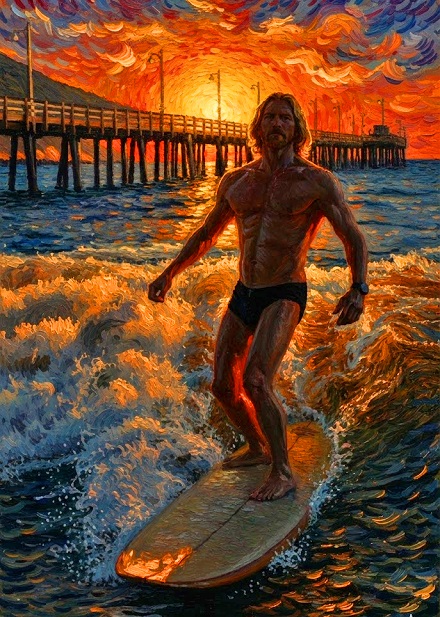
The combined overuse of limited surfing resources by this ever-growing population of young and old users has created conditions within which violent personal confrontations between individuals (over who may or may not surf at a particular spot) presently become more common. The range of violent behavior that characterises ‘surf rage’ spans everything from simple ‘stink-eye’ (a Hawaiian pidgin term that means threatening looks) to acts of near homicidal, very violent battery. Clearly, such behavior cannot be allowed to continue, nor is it appropriate to as beautiful and natural a sport as is surfing the ocean waves in complete spiritual harmony with nature.
Thus crowding, or the sheer impact of increased surfer population density (if viewed within that context solely), has become one of the greatest factors underlying outbreaks of physical violence linked with contending surfing individuals and/or groups who must cope with dramatically increased use of the available surfing sites. The effects of increased population density have been exhaustively studied by behavioral scientists over the past century and there is no longer any doubt that increases in demographic density (whether of human or animal populations) exert consequent pressures among all individuals in those groups (i.e. competition for survival). This factor is as true regarding surfers contending for their favorite breaks as it is for packs of wolves having to compete for reduced herds of favored prey in the wild. Whether for better or worse, this part of the human psychophysiology is a commonly shared vestige of our primitive simian origins.
Another important factor worthy of analysis in any consideration of surf rage is the matter of ‘localism’. That subject has been examined as it exists in Hawaii in another article, but whether in the islands or on the mainland coast, a strong sense of ‘localism’ fuels much of the highly contentious disagreement over who has more of a ‘right’ to surf and who doesn’t in any particular area. In this connection localism intensively promotes (or at least encourages) violent acts like ‘surf rage’. The sense of localism is found in and centered largely upon the question of who has ‘real propriety interests’ in a given area, the idea being that those who live in a particular coastal area have substantially greater right to regard a specific locale as their own more than those who live elsewhere (and must travel from somewhere else to surf).
Localism is to a considerable extent a mutually protective mechanism when it functions to preserve the (assumed) ‘rights’ of a group within a specific area, but as has been perhaps best seen in the Hawaiian Islands example, there are many differing forms that localism may take. In the islands, for example, localism is often the expression of a covert desire by ‘natives’ to gain respect and consideration from outsiders whom they regard as a sort of ‘oppressive, privileged upper class interloper’ (i.e. the classic haole, or economically powerful white mainlander who wrested control of the traditional way of life away from the native Hawaiians); this is certainly true when the ‘locals’ are all part of a distinct racial group or have strong ethnic minority ties, less so when those unifying ties are less obvious (such as in a group of ‘local’ surfers who may not all be native Hawaiians, but who feel pressure from all outsiders equally), but still strong enough to encourage close affiliations.
Localism in human beings is fueled by some of the most basic instincts and needs common to almost all animals: the instinctual desire to belong and be socially accepted by one’s fellow creatures. Localism in that sense may perhaps be used interchangeably with the term ‘gangs’ and ‘local violence’ can then often be understood in terms of amounting to ‘gang violence’, when viewed within that set of definitions.
Often lumped together with the associative term ‘human behavior’, localism can be a very complex anthropomorphic dynamic that eludes easy or simple definition, especially since it is not consistently an outgrowth of any maturely sentient reflection or intellectually derived reasoning process. Localism at its foundation is more likely to be a collective or group dynamic that traces its roots to our most ancient (primitive) instincts for mutual protection and safety, but which is even further complicated by a widely ranging interplay of emotional reactivity to events and interactions with others. Studies of socially gregarious animal groups (such as wolves) that display this sort of collective protective interaction are a bit less complex, when compared to groups involving human beings, who suffer the added liability of possessing reasoning ability (thus considerably muddying up the waters of motivational understanding).
Social and cultural anthropologists have often cited the aggregate effects of ‘tribalism’ in describing the behavior of primitive (and even some ‘modern’) groups of human beings and there can be no credible arguing that an even more common link of relatedness and interconnectivity underlies ‘tribalism’. That ‘even more common link’ is the direct blood tie that binds members of family groups to each other. Both tribalism and family interactions share commonalities that have direct and profound bearing on how individuals interact with each other in many ways, including a shared sense of being co-locals.
As gregarious social animals human beings have hard-wired needs for close ties to others of their kind that find a diverse manner of expressions. Since the most basic ‘link’ among human beings is the family relationship wherein parents and siblings all form a social ‘pack’ that carefully delineates roles, delegates duties, supervises individual responsibilities and governs respective behaviors, to a very large extent one could argue that much of the direct blame for a seemingly uniform lack of constraint shown by many individuals in interacting appropriately with others stems from a failure (lack or deficit) of this very early and critical socialisation process. If parents fail to transmit an appropriate appreciation or understanding of social etiquette to their children (for whatever reason), a substitute form of tribal bonding often arises within which the deficit understandings take altered form. Thus gangs, thus synthetic or artificially contrived ‘tribes’, thus ‘localism’…all these structures arise to serve as expedient compensatory substitute mechanisms for basic parental failure to educate children and transmit full awareness of the need for appropriate social behavior (within any culture or small sub-culture).
Basic formative familial socialisation is most readily accomplished within a highly homogenous grouping of individuals, whether that might be a local community, an extended family, a ‘tribe’ or even a small ‘nation’. Any group, whether large or small, that actively promotes mutually harmonious interaction among its members absolutely relies upon all members of that group possessing and sharing similar values. Sharing similar basic values promotes the consequent sharing of outlooks, attitudes, and valuations, all of which act together to enhance the harmony and common good (safety and survival) of that group. When any small group (family, tribe, community, or nation) becomes demographically fragmented, heterogeneously diversified or philosophically polarized, the result is invariably predictable: a socially chaotic behavioral norm takes form that fails to deter aberrant interactions among its individual members. The negative consequences of dysfunctional group dynamics almost invariably act to encourage and perpetuate solidarity and uniformity of action within any given group, thus acts of violence by locals directed against outsiders are generally supported by all in that group (either actively or tacitly).
Regrettably, the failure of the family unit as a critical primary socialisation process that sets (and governs) normative expectations among immature members of the group is often a product of disruptive, diverse forces brought to bear on it from outside. In the United States we have need to look no further than our own American backyard, with its increasingly diverse population of people maintaining every sort of divisive belief, attitude, religious outlook, political sentiment, and/or reflective awareness imaginable. In such a highly heterogeneous society as ours there is little encouragement for families to teach children such immensely important social concepts as tolerance, courtesy, cooperation, acceptance and understanding, since diversity fragments uniformity. Further, the economic forces that govern our affairs (from the basic family unit all the way to highly abstract ‘associations’ that develop from shared interests) are developed and fostered in such a manner as to subjugate the higher spiritual interests of the masses to the overwhelming dictates of commercial corporations that regard them as a faceless resource comprised of unthinking, materialistically obsessed consumers (whose only recognised value is to endlessly consume commercial products). This commercially programmed and ruthlessly driven mad scramble for goods, services and labor that has become America’s socio-economic model, contrary to being a healthy manifestation of enlightened socio-economic organisation, instead tends to disrupt and shift behavioral shaping processes away from the family and towards commercial organisations whose motives are profit-centered.
Thus, due to influences that have their roots in the sort of capitalistic (read: corporate) free-for-all that American Democracy has gradually morphed into, the chances of a family…any family…being able to address (much less control) the crucial behavioral socialisation processes their children critically require to grow to self-actualised, reflective maturity (as socially balanced, wisely aware, and humanely conscionable individuals) are spectacularly minute indeed. The greater effects of this organized disintegrative status quo are felt everywhere in America, as immature individuals, denied their most essential ‘basic training’ in the home seek out a functional substitute elsewhere. This frequently occurs in the formation of youth gangs in the larger, more highly diverse metropolitan areas and in the establishment of the various forms of ‘localism’ one finds in smaller, perhaps more limited and demographically homogenous settings (such as at popular coastal surfing breaks).
Viewed in this context, violent confrontations between individual surfers may seem to be more explainable (if never justified), but there is still another factor at play in this process that does not at first seem to be so apparent. That ‘extra dynamic’ is the pervasiveness of extreme pettiness and immaturity found not just in adolescents today, but in supposedly fully grown adults who although physically full grown, manifest the intelligence, awareness and wisdom of a not yet mature adolescent. Among the qualities manifest in this type of ‘puerile adult’ consciousness (that seems so pervasive everywhere one looks in American society) are narrow self-centeredness, severely deficit recognition of social and individual responsibility, extreme egotism, an inability to see beyond immediate need, and a failure to embrace certain spiritual and aesthetic commonalities all human beings share. Sadly, our uniquely American form of economic (read: corporate commercial) enslavement encourages this unreflective, highly reactive, and intellectually uncomplicated state of being, since such individuals are quite easily manipulated by the devastatingly sophisticated dynamics of modern commercial advertising. We often fail to see or recognise that the dumbing-down process, no matter where it occurs, favors shallowness and profound lack of discernment (both personal and social).
Thus, by failing to adequately socialise their children, the chaotically fragmented American family not only falls directly into the hands of the duplicitous economic forces that presently control all our lives, they also set the conditions within which the more extreme forms of ‘gangism’ and ‘localism’ (international conflict, wars, et al) may all the more easily be exploited by the politically powerful among us. Since in today’s America political power has now become accessible only by those with extreme wealth (eBay founder Margaret ‘Meg’ Whitman is perhaps the most blatantly outrageous example at present, having spent over $110 million thus far in her political campaign for California governor), the entire nation is effectively ruled by extreme wealth, and in corporate America that ‘extreme wealth’ lies in the hands of the largest commercial corporate enterprises. Since the focus of this paper is the more localised expression of surfing violence directed by local surfers against those perceived as outsiders, it might be better to leave the greater causative influences (as necessary context for understanding) and return once more to California’s coast and the effects of ‘surf rage’. Regardless, it is important to recognise the fact that socially harmful forms of localist sentiment in surfing (as ‘surf rage’) are profoundly influenced by the innate socio-economic status quo America has created in turning a blind eye towards rampant and largely unregulated corporate profiteering (most notably over the past 100 years, with the rise of immensely powerful corporate commercial organisations).
I have long maintained that, despite the effects of immature thought manifested by both immature adolescents AND by fully grown adults with the deficit reflectivity of immature juveniles, there is still hope for some change in dealing with violence of the sort in discussion here. Regrettably, that hope continues to diminish, since the only possible way violence of any sort may be dealt with is through intensively homogenous and broadly applied social conditioning that is presently impossible to carry out due to the increasingly heterogeneous (read: diverse) nature of American society. Whereas America once encouraged and embraced diversity as a potentially strong cultural asset, more recent decades of growing and highly polarised cultural diversity have now reversed any benefits formerly conferred by that original enlightened socio-political philosophy and done little more than further divide, separate, and fragmentise American society.
As long as our most basic wants, needs, desires and attitudes are totally controlled by profit-making enterprises (read: corporate commercialism) and governed by powerful, uncaring wealthy interests, the quality of our lives will continue to change adversely. In the surfing world (as in all spheres of socio-economic life in America), immense vested money interests are our worst enemy (in terms of being able to preserve the essential spiritual aspects of our lives and our recreational activities). Big money doesn’t favor, after all, the creation of widespread reflective intelligence, a highly educated population, or broadly humane regard for all life and all people, for big money knows only too well that only ignorance, small-mindedness, irrational anger, hatred, bias, irresponsible reactivity and other forces that are an irreducible part of the human matrix may be successfully harnessed to generate corporate profit. It is not in their best interests to change these conditions and it is therefore our individual duty and responsibility to follow Nat Young’s example (as outlined in his book) and adopt a more forgiving nature towards others.
At one time I felt that most of the violence, ignorance and gratuitous hatred directed towards others that we see every day in America stemmed principally from aspects of inherent immaturity manifest in younger individuals, but I quickly learned that advanced age in itself is not necessarily an advantage in promoting a less violent interaction between diverse individuals that may not share basic commonalities, since intelligence, education, and a host of other factors also relate to the matter with equal impact.Just as there are a great number of post-doctoral individuals about who lack good common sense, there are equal numbers of older, supposedly more mature individuals in our society who are no wiser than they were just after puberty engulfed and fused their minimal reasoning circuits.
Back in the late 1940s and early 50s, surf culture was a far more unstructured and vastly more natural phenomenon than it is today, some 50 years after commercial money interests began to exploit and ruin things. In the manner of ancient Hawaiian family elders who educated their children to respect and treat others with consideration and love, elders of the surf tribe in those days encouraged younger surfers to get involved under their aegis and took the time required to instruct them, help them gain skills and abilities, and in general encouraged understanding on their part of the social obligations and responsibilities that were a traditional part of the activity. As the sport grew, as a distorted reflection of the greater and socially exploitative American socio-economic model, those critical socialising aspects of surfing were gradually supplanted by an unhealthy emphasis on highly aggressive competitiveness, selfish protectiveness and polarized social fragmentation. The result was (and is) predictable, as the worst expressions of ‘localism’ resulted in acts of surf rage violence directed against others.
With the introduction of further elements of disruptive influence that include abuse of substances and participation in surfing by individuals possessed of lowered awareness and/or social understanding (read: the reactively ignorant) now contributing to this already well established problem, surf violence continues to pose a major concern for recreational surfers along the California coastline today. As cultural diversity (social, ethnic, economic, and intellectual) increases, chances lessen correspondingly that any broader cure for surf rage will come about in the immediate future. Enforcement of humane, kindly regard for others through laws and statutory enactments that specifically classify acts of surf rage as punishable forms of assault and battery are only a virtual Band-Aid on a figuratively gaping shark bite. The greater need is to educate others from the earliest moments of life and that process must always start at home with the loving, concerned ministrations of a family.
If saving the family requires taking a harder, less forgiving look at the freakishly nightmarish consumer madness that America has become over the past half century, perhaps it is time for that most precarious reappraisal of the precepts of American Democracy to be undertaken. Meanwhile, books like that written by Nat Young are a positive step forward in getting the message out that surf rage cannot be tolerated in a recreational venue that in its original and most classic form embraces the purity of human interactions with the mother oceans and that promotes loving regard of all of nature’s creatures (especially the human ones) that share this beautiful planet.
Aloha mai e, Haumea!