Ritter der Lüfte: Chivalry in 2WK aerial combat
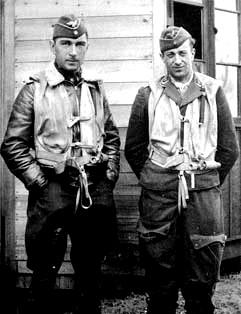
Very recently a book was published titled ‘A Higher call: An incredible true story of combat and chivalry in the war-torn skies of World War 2’.
The book written about this remarkable act of chivalrous decency by a German pilot is certainly well worth reading, but at the same time begs the question ‘Is the ancient and honorable code of chivalry obsolesced by modern war?’
Chivalry, as most of us know, originated in the Middle Ages, where it began as an aristocratic code of personal conduct for medieval knights. What most of us don’t know is that although the word ‘chivalry’ is taken from the 11th Century French word ‘Chevalier’ (meaning ‘knight’ or ‘horseman’), chivalrous behavior actually derived from an idealized German custom that codified the duty of knights to champion others who were unable to protect themselves. The code required of knights that they be personally strong, morally pure, honorable, disciplined and courteous to all; above all, they were expected to use their power selflessly to promote good.
As warfare progressed from the Medieval period up through the 19th Century, codes of chivalry remained strongly a part of the warrior classes of most European nations, despite the fact that in many nations age-old monarchies had yielded to more recent systems of social and political governance, thereupon disenfranchising the power of nobles and the warrior class (ending the need for a chivalrous code of conduct among combatants, since traditional honor codes were replaced by contemporary international agreements, such as the articles of the Geneva Convention).
In Germany, the nation that had originally given rise to chivalry (and a nation in which noble titles still possessed considerable influence), formal, strong traditions of chivalrous conduct remained in place, although with the advent of modern mechanized, technologically enhanced warfare, ‘quaint’ chivalrous customs quickly fell away amidst the brutal and extreme violence that characterised 1WK trench warfare. As the harsh reality of the ‘new’ forms of technology-enhanced warfare acted to lessen regard for traditional attitudes of fairness and nobility among ground troops, there were still occasional manifestations to be seen (e.g. as in Christmas truces and temporary ceasefires) in the trenches; further, in the newly formed air services of the 1WK, fliers on both sides of the conflict tended to regard themselves as the new ‘knights of the air’ (‘Ritter der Lüfte’), inheriting to some extent the ancient traditions of chivalrous behavior towards enemies. This was the case at least in the German Air Service of the early 1900s, since just as in medieval times, whereby a knight’s code of conduct set him distinctly apart from the common warrior, the aviator’s exclusivity and élan set him significantly apart from the common Landser in the trenches.
In England, there was quite a different mind-set, although it paralleled to a substantial degree the Germanic code of chivalry. When the Royal Flying Corps was formed in the early 1900s, candidates for flight training tended to be from upper-class families and were usually possessed of both money and family influence, since the fledgling air service was regarded as being rather a gentleman’s calling. Further, as student pilots had to provide their own kit and equipment to a substantial extent, the lower-class individual had little chance of becoming an aviator even if he had the requisite aptitude to learn to fly.
Accordingly most all 1WK English aviators were public school graduates and affluent scions of prestigious families, imbued with a traditional English sense of ‘fair play’ and polo field sportsmanship. The formal rules of cricket and polo, both sports traditionally identified to the English upper classes, demanded a strong sense of ‘old boy’ fairness and honorable behavior (both on and off the pitch). With most English pilots coming from that social background, these qualities were reflected in the attitudes of the new aviators as they engaged the enemy over the trenches. It was considered ‘bad form’ to take unfair advantage of an opponent or engage in aerial ‘trickery’, and the unspoken rules of engagement stressed this to an almost palpable degree.
As aerial warfare progressed to a far more modern level of development in the late 1930s, with formidable new forms of powerful aerial weaponry coming into use, the concept of fairness was perhaps terminally impacted by the need to quickly dispatch and kill one’s antagonists before one suffered the same fate. Due to modern advances in the ‘art of mechanized aerial killing’, most pretensions of chivalrous behavior quickly dissipated in the chaotic dogfights that occurred among fighter pilots of opposing nations. It became apparent that the more prudent operative axiom was ‘kill or be killed’ in order to survive, and the sooner and more skillfully done the better. Luftwaffe fighter pilots rapidly became calmly calculating ‘experten’ at their game, and on the Allied side the ‘polite’ old school courtesies also quickly vanished. There was, simply stated, no longer allowance for the old codes of honor in a sky dominated by fast, well-armed and high-performance aircraft. Death is, after all, death…
Paradoxically, as the intensity of the war advanced, despite enduring savageries of the most terrible sort and being forced to think and behave more like a killing machine than a noble, knightly warrior, seemingly anomalous acts of occasional mercy, courteousness and ‘sportsmanship’ could (and did, as witnessed in ‘A Higher Call’) nonetheless occur, both among the ‘Ritter der Lüfte’ and the Allied Air Forces of the 2WK.
Is the ‘age of chivalry’ dead in today’s modern and highly technologized era of aerial warfare? I think it is safe to say that it is, perhaps sadly, irrevocably and permanently kaput.