 Second in a series of brief articles written for publication in 'Der Adler', the official newsletter of the LARA (Luftwaffe Aircrew Reenactors Association), which despite their brevity, may still be of interest to the military history buff.
Wir müssen Sauerstoff!
German aviator breathing systems
in the 2WK
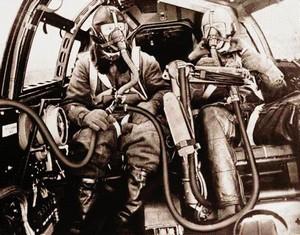
Much has been said in the decades since the end of the Zweite Weltkrieg about the aviator oxygen masks used by the Deutsches Luftwaffe. Books such as Anders Skotte’s seminal reference (German Luftwaffe Flight Headgear of World War Two: A Collector’s Guide) are a standard reference on any true Luftwaffe re-enactor’s bookshelf and in it, as well as in several others, may be found both data and illustrations of the most commonly used aviator oxygen masks used by German flight crews during the war. To therefore spend much time here on that particular subject would be covering ground long familiar to most of us concerned with creating Luftwaffe pilot impressions. What is not quite as well known is the historical backstory of the actual physiological research developments that enabled these masks to provide life support at altitude in Luftwaffe aircraft.
Not surprisingly, Germany largely pioneered the area of hypobaric physiology and life support involving use of oxygen (Sauerstoff) to permit ascent to higher altitudes, beginning back in the late 1800s when the first attempts at altitude records were being made in lighter-than-air craft (balloons). Motivated by German high-altitude mountaineering expeditions, much of the basic clinical theory of human medical physiology at sea level was applied to the problem of supporting life in areas of lowered ambient pressure through use of supplemental oxygen. By 1901, the scientific observations of Viennese physiologist Herman von Schrotter enabled two academicians (Suring & Berson) to attempt an altitude record in their balloon (the ‘Preussen’), breathing oxygen through a pipe-stem mouthpiece (despite Schrotter’s recommendation that a secured facemask be used and a near fatal hypoxemic event), finally reaching a height of 10,515 meters (34,500 feet). Extrapolation of important data obtained from this and further research studies accurately confirmed that ambient atmospheric oxygen was only adequate for flight at altitudes below about 3,000 meters (9,800 feet); it was further determined that above 12,497 meters (41,000 feet), even 100% oxygen would not sustain human life unless it were somehow pressurized. Further, it became apparent that traditional pipe-stem type oxygen delivery devices were unsafe, given that leaks at the mouth or involuntary release of the pipe-stem could quickly result in fatal hypoxemia (deficient systemic oxygen). Masks were, therefore, determined to be mandatory for aviators who flew without the benefit of a pressurized cabin on their craft. Yet even with whole face aviator masks (inspired by gas mask designs), adequate face-seal was recognised as being critically important, since a leak could and often did occur, with predictably deadly results at higher altitudes.
In the 1930s there was much interest in Germany in the promise of both pressure-suits and in pressurized crew cabins (both enabled by aircraft supercharger technology), but owing to the rather rudimentary limitations of technology and inadequate materials technology required for both (not to mention the crushing press of wartime production priorities after 1940), neither course was successfully pursued by the Reich’s Lufts Ministerium (RLM) during the war to an appreciable degree. Instead, oxygen masks were standardized for all Luftwaffe aircrew flights above the specified ‘safe’ altitude of 3,000 meters (9,800 feet). Interestingly, and far ahead of its contemporaries, Germany had early-on focused on the problems of limited supply presented by use of ‘continuous flow’ and ‘rebreathing’ gaseous oxygen systems and even by 1913 had produced liquid oxygen equipment for balloon flights that that could easily be refined for use in aircraft. In 1941 the demand regulator was installed in German aircraft for use with the various oxygen masks standardized by the Reich’s Air Ministry (RLM). Extensive experimental research carried out in He-117 and Do-17 aircraft by the Erprobungstelle der Luftwaffe, Rechlin, had satisfactorily demonstrated that oxygen masks, properly used in association with a demand regulator and a liquid oxygen system, could assure adequate, safe aircrew life support up to within 3,048 meters (10,000 feet) of the absolute 12,497 meter (41,000 feet) ceiling of flight operations.
Beyond that height, it was recognised by researchers at Germany’s Luftfahrtmedizinisch Forschungsinstitut, Berlin, in the late 30s that some sort of pressurized atmosphere (external to the surfacd of the body) was required to fly near or above the 12,497 meter operational ceiling, since at that height prolonged flight without whole body pressurization would result in severely disabling decompression sickness (Nitrogen narcosis, sometimes known as ‘the bends’); but due to inadequate pressure suit or pressurized cabin technology, the only method of enabling aviators to safely fly to altitudes of about 9,144 meters (30,000 feet)…and only very briefly at the upper limit of 12,500 meters (41,000 feet)…was through use of the ‘pressure-demand’ oxygen system. This system, which cycles a higher-than-ambient pressurized oxygen mixture to the crewman upon inspiratory demand, helped overcome the potential for leaks to a great degree and it also helped boost alveolar oxygen (partial pressure of blood in alveoli of the lung) to acceptable levels (in a pressure-demand system the pressure within the mask is always higher than that of the surrounding atmosphere at any given moment in the breathing cycle).
It was carefully noted by German researchers at the LF, however, that pressure-breathing is a very ‘unnatural’ method of breathing and can be somewhat taxing and fatiguing…especially when carried out over long periods and during strenuous activity (e.g. in aerial combat). Furthermore, the effects of positive pressure breathing on diminished systemic blood (and cardiac) circulation can be notable because of their association with the development of altitude sickness. The decision was therefore made to not develop pressure-breathing for Luftwaffe aircraft by the Luftfahrtmedizinische Forshungsinstitut . Documents from that era indicate that this was chiefly done so as to provide fliers with ‘the greatest possible comfort in breathing’. Given the typically precise German consideration of ALL factors applicable to operational flight by Luftwaffe aircrews, however, before this policy was finalized and enacted the opinion of experienced fliers was solicited by the LF and factored into the RLM’s final decision.
For these reasons, Germany elected not to use pressure-demand oxygen breathing systems in its combat aircraft during the 2WK period and in that one context lagged significantly behind the Allies, who did develop the pressure-demand system and introduced it as a standard in all USAAF aircraft by late 1944/early 1945 (it remains in use today as a standard for USAF aircraft). The Allies, on the other hand, did not fully explore the potential of liquid oxygen systems until the late 40s and early 50s, after which they too replaced traditional compressed gaseous oxygen storage on aircraft completely (a standard that remained in place until only very recently, with ‘OBOGS’).
It is worth noting in passing that one other remarkable area of German research carried out in the 30s by Luftwaffe researchers at the RLM concerns a development that is now standard on all advanced military aircraft known as OBOGS, or the ‘Onboard Oxygen Generating System’. OBOGS supercools concentrated atmospheric air and separates out the oxygen, compressing it for use in breathing. The first widespread use of that advanced system in military aircraft (by the USA) didn’t occur until fully half a century after the RLM had tentatively explored its potential for use as a military aircraft breathing system!
During the war, the Dräger and Auer companies were the chief suppliers of respiratory apparatus to the German Luftwaffe (and Wehrmacht), although the much larger Dräger company provided most (75-80%) of the Luftwaffe’s oxygen breathing systems and both subcontracted their production orders to each other. [Note: Today, genuine and original specimens of the WW2 era Dräger /Auer aviator breathing masks (like all other war era artifacts) cost collectors great sums and regrettably there are no modern replications available for re-enactors to use in their impressions.]
When the war finally ended, both the Soviet Union and the Allies quickly secured as much of the vast wartime research database in aerospace medicine and flight physiology amassed by Germany’s RLM as possible, that data forming the foundation of most subsequent ALS (Aircrew Life Support) development , by both sides in the coming ‘jet era’. That heritage is, in the opinion of many, a most fitting testimony to the excellent scientific achievements that characterised the RLM’s pioneering developments in aircrew life support during the war. In the span of a single decade, despite the stressful urgency of a war economy and the great pressures brought to bear on Germany in the final years of the conflict, the pioneering accomplishments of the Luftwaffe’s biomedical and high altitude research programs live on today as the foundation of all modern aerospace medical science.
|