Fire Agate Winter Day
by Erin Elizabeth Kelly-Moen — Read all 1,670 poems by Erin Elizabeth Kelly-Moen
Friday, January 23, 2004
The anticipation builds as they drive,
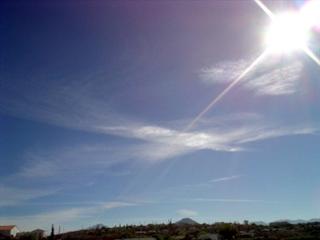
sky a pale blue, some wispy clouds
shadow the mountain peaks. Brown,
everything is brown, and dulled in
winter desert style. They reach the turn-off
through the Black Hills of southeast Arizona,
prime fire agate territory. She thinks back
ten years, when her oldest daughter
was not yet three and rode in a back-pack carrier
attached to her father, constantly
upsetting his balance as he traversed
the rocky slopes of gem stones genesis.
Passing over the shallow green waters of the Gila River,
we head up the east flank of scalloped heights.
Not far, now, just through the winding ten miles of craggy buttes.
In the eons past, there had been volcanic activity
attached to a uniqueness of chemistry and impurities;
basalt’s friable bubbly form harbored chalcedony,
earth’s heated blood solidified into flowing diversity.
The familiar vertical ‘chimney’, the last remains
of an eroded volcano, towers into view.
The uneven ground becomes littered
with white opaqueness. Angles and curves,
bubbles and mushrooms, fractured fragments,
ovals, rounds…fantastic forms overwhelm the senses.
Clear, white, cloudy, milky, mixed-the varying contrasts
are interspersed with earthy tones and reds;
layered, dotted, blurred, the differences
are extravagantly gorgeous.
Doors open, fanny packs and water bottles
are grabbed, boasts of who will find the biggest
piece of fire agate fly. Three of the four family members
become engrossed in ground-watching,
the infrequent spark of weather-excavated prize
has an elusive nature. The youngest daughter
decides to dissect a beavertail cactus pad,
using utmost eight-year-old care. Favorite areas are checked,
the sun’s angled rays help vision’s ability
to pick out one special gleam
from a hundred others.
Most chalcedony develops as a silicate precipitate
from aqueous solutions which fill cracks and hollows.
Banded agates are the most common, micro-grained
and crystalline, but also included are flint, onyx,
jasper and carnelian, used as an ornamental rock.
Fire agate, however, is deemed semi-precious,
its darkly opalized colors of gold, copper,
maroon and pure green shifts and glows
with an inner life of mineralized beauty.
The State site is popular, the view is magnificent,
Mount Graham broods large in the distance,
the gentle wind encapsulates the body with
it’s sloughed sighing song. Years of rock hounding
have drained the surfaced skin, fragments and bits,
not the inch wide pieces of older hunts, are all
that is found. She feels an aura of disappointment.
Brags about her ‘world’s smallest fire agate’ find,
tucked safely into her jean pocket, they laugh
as she quietly mourns and laments fires scarcity.
For now, the Black Hills hides its flaming treasures
in its depths, under the rubble strewn slopes
of a mountain once tall and mighty.
Erin Elizabeth Kelly-Moen
Picture/artwork by Erin Elizabeth Kelly-Moen
© Copyright 1/23/04



 Share
Share Print
Print Save
Save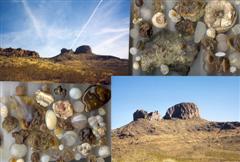









♫ Jackie
This spoke to me over here in CA.....the beauty of rocks and gems taught to me by my grandmother..."become engrossed in ground-watching, the infrequent spark of weather-excavated prize
has an elusive nature" ...that's me too...I felt like I had joined a very special event....
Once again enjoyed Fire Agate Winter Day....
jeanne rene