(Jean Franco, born in Morocco of Spanish stock, was an Income Tax Inspector and in his spare-time an International Soccer Referee for France. We often played tennis at the Tennis Club in Fresnes-94 - where watched by thousands in neighbouring tenement flats - our disputatious voices in pure glee over every point rang loud and clear.)
Jean Franco's residence lies along the highway which leads directly to the Versailles Palace, and in the 18th century happened to be Her Royal Highness Marie Antoinette's trysting place. Her Highness's famous retort when informed that a revolution was taking place owing to the lack of bread for the common folk was: "Why don't they eat cake then ?"
Now you are put to rest
by T. Wignesan
for Jean Franco
(March 15, 1907- April 15, 1992)
I
They opened his abdomen
found what they were not looking for
though half-expected
to see
polyps enormous cancerous mush
in lieu of
and the rest that had given out on him
They said: if we had known we wouldn't have torn into his
tripes
to see
even the sample test told us as much
but we did it for him
he so wanted it done
now we merely have to wait and see
just how long it would take him to conk out
without solid food to pass
from his newly-grafted conduite
He was completely in their hands
and hung on to their lips their every nod
their plans for him
and the use he had for their
apprentis chirugiens sorciers
He kept his anger for his friends family telephone operators
the aide-soignantes
those he could intimidate with his age
for he didn't know what they knew
they wouldn't feel the hurt the slight
for long
the rankling umbrage sans riposte
He didn't mind all the inconvenience
the constant waking to pass water
the secluded room without tv
without his wife to take it out on
without the means to exude
his usual referee's contempt of rules
In their hands he was the meek inept thing
pleading with his eyes
his whole body bent to their gaze
of wonder
of why he would so question going
now then or even a little later
II
You had said when I kidded you
After all I'm not going to be far away
Now you are put to rest
In a place dug and slabbed for you alone
As if you were not going to rest for good
with all the others
It is a place to a side in the pebble-strewn sidewalk
against the wall
your feet to the east
all the other feet to the south
As of a general standing to a salute from his army
There was no sight of you
The golden chocolatish-pink of your casket
made more glittering the cross
I couldn't guess if you would have wanted the Church's ornament
then the feeling of being out-of-place
thoughts of you in a cloud
We talked in suppressed tones
about you of you
trying to be polite and succeeding among uneasy fellows
here and there some unwanted details slipped in through nervousness
yet none felt your hand tremble on the racket
You were the master of the court
as now you mastered your going by the low sleek slate-grained marble
in sharply polished angular correctness
amidst shy upright cypresses and neatly cut passageways of chipped stone
We sprinkled your tomb with Church water
Neither rain nor snow you remember could keep you from finishing your game
Already as we turned in a column the voices now louder in the distance
They were arranging the roughly hewn stone slabs
before the marble thickened your bed
You may at last be at rest
with no one to challenge you to a test of strength
your referee's whistle holding its un-disputable silence
You came with the spring
Now you go in cheery spring
Your sollicitous voice still lingers in our courts
You knew us all by name and style at play
long before we met under your critical gaze
(Jean Franco, born in Morocco of Spanish stock, was an Income Tax Inspector and in his spare-time an International Soccer Referee for France. We often played tennis at the Tennis Club in Fresnes-94.)
[ABOUT THE POET ~
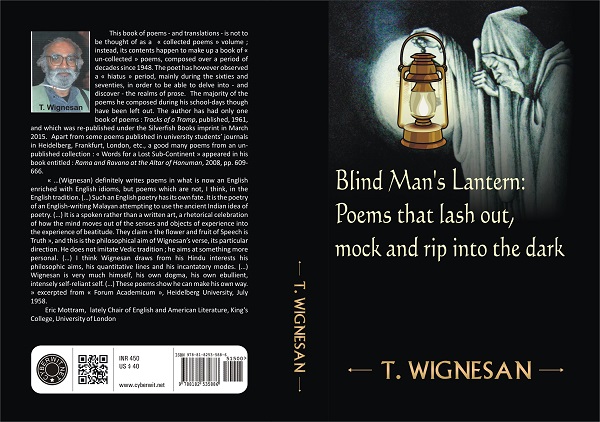
If I might be allowed to say so, I think my "first" love was poetry. Unfortunately for me, the British curricula at school did not put me in touch with the Metaphysical Poets, nor with the post-Georgian school. Almost all the school texts after World War II contained invariably Victorian narrative poems and some popular examples of Romantic poetry. I chanced upon a selection of T. S. Eliot's and Fitzgerald's Rubaiyat of Omar Khayyam, and a little later on Pope's An Essay on Man and Chaucer’s Canterbury Tales. That did the trick. Yet, I regret not having taken to prose in earnest earlier than the publication of my first collection: Tracks of a Tramp (1961). There's nothing like trying your hand at all kinds of prose exercises to come to grips with poetry. Or rather to see how poetry makes for the essence of speech/Speech and makes you realise how it can communicate what prose cannot easily convey. I have managed to put together several collections of poems, but never actually sought to find homes for them in magazines, periodicals or anthologies.]
Want to review or comment on this poem?
Need a FREE Reader Membership?
Reviews of "Now you are put to rest, for Jean Franco - 1907 - 1992"
Many thanks to both you "un-repentable" flatterers ! There's just an anecdote I'd like to add for your greater edification:
Franco's wife, a tall beautiful Nordic-looking distinguished and dignified lady, had come looking for me some years later for she wanted me to find a gardener to work her cloistered back-garden for it had become infested with wildly-growing weeds. I happened to cross the street just before nearing the old medieval Church (in the pilgrimage route of Santiago de Compostella in Spain) in the centre of Fresnes-94.
I actually saw Franco striving on his rickety old bicycle up the gradient, and no sooner I gained the sidewalk opposite, I bumped into Madame Franco. She said she saw Franco, too, on the bicycle in his dark pullover and black gym-longs. Not for the first time, though!
The typescript of the poem was allowed to be placed on Franco's casket. She wanted a translation into French that I never got round to doing (miserable me), so years later I went looking for her and to my great surprise, no member of her family (her son(-in-law ?) a police inspector at Bordeaux, his wife and Franco's grand-daughter - a replica of her grand-mother) were alive ! [Franco had a family on the sly (whom I got to know on visits at the sick-bed, and the present owner of the residence said they had gone to live in the Swiss-French Alps.]
Just a word about the A.A.S. Fresnes Tennis Club. A wholly reserved and self-taught Algerian ranked some 200 on the ATP, and what's worse, he beat Carlos Moya ranked 30. Likewise an under-eighteen: Moreau (I think by name), living close by in Rungis, was the Champion - at seventeen - of the World in her category; yet her professional career ended then and there. Freak out, Ladies and Gentlemen, s'il vous plaît !!! Best. TW
You are very adept at writing poetic obituaries. This one is a brilliant example of how you made a man much greater than the man he was.
You are bringing back these death stories to share with us perhaps because you think that your time is coming. Which makes me wonder if there is someone that you know that knows you well enough to write such brilliant words about you that you have done for others.
I've come back to read this several times, and it keeps growing on me. I like the dreamy quality of it. I don't know if that is your meaning with it, but none the less I can see the surroundings, the characters, their display of body language and facial expressions before my minds eye sort of like I see things I dream about. You have made the life of Jean Franco, as it was lived when you knew him and his character visible for me. Great work! When will we get to read some recent poetry from you?


 Share
Share Print
Print Save
Save Follow




Franco's wife, a tall beautiful Nordic-looking distinguished and dignified lady, had come looking for me some years later for she wanted me to find a gardener to work her cloistered back-garden for it had become infested with wildly-growing weeds. I happened to cross the street just before nearing the old medieval Church (in the pilgrimage route of Santiago de Compostella in Spain) in the centre of Fresnes-94.
I actually saw Franco striving on his rickety old bicycle up the gradient, and no sooner I gained the sidewalk opposite, I bumped into Madame Franco. She said she saw Franco, too, on the bicycle in his dark pullover and black gym-longs. Not for the first time, though!
The typescript of the poem was allowed to be placed on Franco's casket. She wanted a translation into French that I never got round to doing (miserable me), so years later I went looking for her and to my great surprise, no member of her family (her son(-in-law ?) a police inspector at Bordeaux, his wife and Franco's grand-daughter - a replica of her grand-mother) were alive ! [Franco had a family on the sly (whom I got to know on visits at the sick-bed, and the present owner of the residence said they had gone to live in the Swiss-French Alps.]
Just a word about the A.A.S. Fresnes Tennis Club. A wholly reserved and self-taught Algerian ranked some 200 on the ATP, and what's worse, he beat Carlos Moya ranked 30. Likewise an under-eighteen: Moreau (I think by name), living close by in Rungis, was the Champion - at seventeen - of the World in her category; yet her professional career ended then and there. Freak out, Ladies and Gentlemen, s'il vous plaît !!! Best. TW
You are bringing back these death stories to share with us perhaps because you think that your time is coming. Which makes me wonder if there is someone that you know that knows you well enough to write such brilliant words about you that you have done for others.
Ron