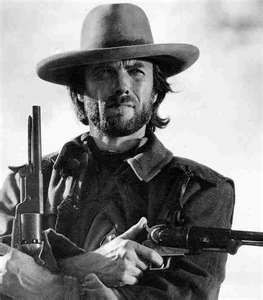
 John Wayne and Clint Eastwood: cowboys in contrast.
Bam, bam, shoot ‘em up, pow!
The cowboy who epitomized rugged, individualistic, masculinity endured as a cultural icon in the Sixties despite relaxation of social taboos relating to sexism, and retaliation against conservatism, social conformity, and our government’s escalating military involvement in Vietnam.
San Francisco on the West Coast may have popularized the Hippie culture—Scott MacKenzie’s “gentle people with flowers in their hair,” but the Midwest held its ground as a vast frontier for Western films.
Two high plains drifters of the cinematic Sixties-- in horse sense, dual horsemen of a different color, were John Wayne and Clint Eastwood.
Cast in the role of Western hero, John Wayne fought the conflict between good and evil where his fictional composite built an image of a no-nonsense, stalwart, and stoic folk hero on screen and off—with reservation. Clint Eastwood, the sexy cowboy—sleek, slick, grizzled, tough, straightforward, morally ambiguous, smart, and opportunistic-- prevailed over the bad and the ugly of humanity on the harsh frontier. Yippie yi yo kayah!
Marion Mitchell Morrison -John Wayne, the Duke: Western movie film credits to carve notches in his holster belt include: 1960 -The Alamo, North to Alaska; 1961 – The Comancheros; 1962 – How the West Was Won, The Man Who Shot Liberty Valance; 1963 – McLintock; 1965 – The Sons of Katie Elder; 1967 – El Dorado, The War Wagon; 1969 – True Grit, The Undefeated.
“Whoa, take ‘er easy there, Pilgrim.”
John Wayne’s character, Tom Doniphon uses the word “pilgrim” 23 times when speaking to Ransom Stoddard, played by James Stewart in the film, 'The Man Who Shot Liberty Valance.' Apparently, this pilgrim lacked the True Grits and Rio Bravo to serve his country during WWII even though many of his peers, including Jimmy Stewart, left their Hollywood careers behind to go overseas.
Okay, John Wayne was 34 at the time of Pearl Harbor and was classified as 3-A (family deferment). However, in 1944, he was reclassified as 1-A (draft eligible), but the studio intervened to obtain a 2-A deferment. One could cite John Wayne for draft evasion, bordering on draft dodging, depending on how you take aim.
Ironically, this same man who wouldn’t step out of his cowboy boots to slip on a pair of combat boots, was a war hero in several patriotic films. In large part due to his starring role in the film 'Sands of Iwo Jima,' the false machismo and patriotism rationed him an icon to the Marines. His name attached to the P-38 “John Wayne” can opener implied it “can do anything”. C-Ration crackers referred to as “John Wayne crackers” suggested only someone as tough as The Duke can eat them.
Fast forward to the Sixties, where the actor who wouldn’t saddle up for his country, became one of the outspoken supporters of the Vietnam War. In 1968, he produced, co-directed, and starred in the critically panned 'The Green Berets,' the only feature film of the time to openly support the war.
Ready? On May 26, 1979, the US Congress formally recognized the “actor” for his enduring status as an iconic American by awarding him the Congressional Gold Medal.
"On top of spaghetti, All covered with cheese, I lost my poor meatball when somebody sneezed."
In the 1960s, Spaghetti Westerns grew in popularity—archetypal films characterized by their production in Italian dialogue, low budget, minimalist cinematography shot at various inexpensive locales in Italy resembling the American Southwest or Mexico, violence, and out of sync lip movements post-production for translation into English. The most acclaimed foreign made films served al dente to moviegoers in America were Spaghetti a la Sergio Leone spiced with Clint Eastwood.
A trilogy of Spaghetti Westerns made “Blondie” one of the biggest international screen legends with future pastabilities for simmering in the sauce: A Fistful of Dollars (1964), For a Few Dollars More (1965), and The Good, the Bad, and the Ugly (1966).
Clint Eastwood, who received a straight salary for the first two moneymakers, only agreed to make the third film in the trilogy if paid $250,000 and 10 % of the profits. Strained to begin with, relations between Leone and Eastwood further deteriorated during dubbing sessions because Eastwood refused to read a different script from the original used in the film.
Charismatic and tough off screen as on—no punk—that’s for sure, Clint Eastwood walked the walk by serving our country. Drafted into the army during the Korean War, Eastwood was sent to Fort Ord in Monterey, California, where he remained until discharged in 1953. While in the army, he met actors David Janssen and Martin Milner, convincing him to move to Los Angeles after he finished his military duty. There, Eastwood took a screen test and signed a contract with Universal for $75 a week. “The Man with No Name” has been sitting tall in the saddle ever since, whether in front of a camera or behind it.
“In this world there's two kinds of people, my friend. Those with loaded guns, and those who dig. You dig.” Clint Eastwood (Blondie) – 'The Good, the Bad, and the Ugly.'
|










I remember Clint Eastwood first as Rowdy Yates in the TV series Rawhide. That was the break that got him into the spaghetti westerns. And, I think that those films were shot in Spain, not Italy, but I didn't check so I may be wrong. I do remember my mother telling me well before he played that role, that she thought that Lee Van Cleef was the most handsome man in Hollywood… Imagine that?
Ron