 Ahoy! Crest the Wave of America’s Cup Yacht Racing ...
Shouting an ahoy to native Rhode Islanders and visitors to set sail through the history of yacht racing by touring Bristol’s Herreshoff Marine Museum/America’s Cup Hall of Fame, one of our nation's most prominently historic maritime institutions when it comes to filling America’s Cup with a legacy of victory.
More than a test of wills, the America’s Cup match races between two yachts are testament to the navigation of skills required to win the coveted Cup trophy: sailing, boat and sail design, fund-raising, and management.
The oldest active trophy in international sport, the coveted Cup is to vie for between one yacht known as the “defender,” representing the yacht club who currently holds the America’s Cup, and the second yacht known as the “challenger,” representing the yacht club contending for the grand prize.
Prior to cresting the wave of RI’s yacht racing history which gained knots in 1930, let’s embark on a crow’s nest eye view of the sport’s inception from the perspective of "Hickok Sports":
On August 22, 1851, the schooner 'America' won a race against 15 English yachts around the Isle of Wight. Henceforth, it was awarded a silver trophy by the Royal Yacht Club’s Squadron—the Hundred Guineas Cup, a silver ewer 2 feet, 3 inches high, and weighing 8 pounds, 6 ounces. The trophy was renamed the America’s Cup after the boat. Six years later, the outfit which built the yacht, donated the Cup to the New York Yacht Club, under the terms of the “Deed of Gift” which made the Cup available for perpetual competition. Therefore, any yacht club meeting the requirements specified in the Deed has the right to challenge the yacht club holding the Cup. If the challenging yacht club wins the match, the trophy is transferred.
Aye, aye, not seeing eye-to-eye, the first challenge after the fact did not occur until 1868 when James Ashbury of England challenged his schooner 'Cambria' against any American vessel. The New York Yacht Club set forth the ultimatum that any challenger would have to take on an entire fleet the way America had attained victory.
Finally, in 1870, the NYYC agreed on a best four-out-of-seven series with a single defending vessel in each race, but reserving the right to change defenders from day to day. Our 'Columbia' defeated Ashbury’s 'Livonia' in the first two races, but lost the third due to malfunctioning steering gear. 'Sappho' took over to win the next two races, and NYYC kept the cup.
Obviously, this could go on and on--yachta, yachta, yachta--as the rules keep changing along the way.
Nevertheless, during the third challenge posed by Canada’s Countess of Dufferin in 1876, the NYYC had a single defending yacht, 'Madeline.' Since then, America’s Cup races have always involved a single defender against a single challenger. However, the format of the series changed several times: two out of three races (1876 – 1887); three out of five (1893 – 1903); four out of seven (1930 – 1987, 1992); two out of three in 1988; five out of nine in 1995. Maritime mercy!
Besides bickering, the oldest international sport is not without rancor. A tempest brewed over the argument that even though the series eventually moved from New York Harbor to the open seas off the New York-New Jersey coast, the defenders were still favored due to their knowledge of local waters. Henceforth, the waves crested for this prestigious event to be held off Newport, Rhode Island.
In 1930, Newport hosted the Cup races for the first time and prevailed by hosting the next eleven challenges. By then, the club rules of engagement adopted the Universal Rule J Class as the America’s Cup yacht. This did not bode well as it appeared America’s Cup racing would come to a halt coinciding with the end of World War II. The NYYC reconsidered, and decided to switch to the smaller, less expensive 12-meter class. This appeared to reinstate and insure the longevity of racing on the high seas for the coveted Cup. This class was used until replaced in 1990 by the International America’s Cup Class. Those Nauti boys!
If all of this turmoil on the Atlantic seaboard has induced motion sickness, abandon ship and take a landlubber tour of Herreshoff Marine Museum/America’s Cup Hall of Fame. Located at 1 Burnsides St., Bristol, this maritime museum is one of our nation’s most historic institutions noted for hosting classic yacht regattas, as well as designing and restoring these commemorative sea going vessels.
Exhibits throughout the museum acquaint visitors with yachts associated with America’s Cup. The America’s Cup Hall of Fame pays tribute to those who’ve contributed to these prestigious racing endeavors.
According to information cited on the website, the Museum itself has a rich history seaworthy as Rhode Island’s own clear broth “chowda” made with quahogs from the brine. In 1878, John Brown Herreshoff, a blind boat builder from the town of Bristol, formed a partnership with his brother, Nathaniel Green Herreshoff, a naval architect and steam engineer. Their enterprise became the Herreshoff Manufacturing Company, garnering a reputation for building some of the world’s fastest steam yachts and torpedo boats.
However, their sails billowed full mast with the production of racing and cruising sailboats up to 162 feet in length. Between 1893 – 1934, Nathaniel was given accolades for having designed and built eight of the largest, complex, and powerful racing sloops in the world—all consecutive and successful defenders of America’s Cup!
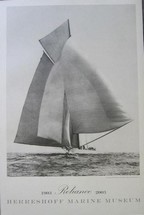
Most endearing to this native of the Ocean State, Rhode Island’s oldest boat, 'Sprite,' also purported to be the oldest existing private yacht in the country, and 'Reliance,' the largest America’s Cup yacht ever built, were Herreshoff designs made on site in Bristol!
Rhode Island residents and visitors from far and wide can tie a few nautical knots, metaphorically sailing through the history of yacht racing by touring Herreshoff Marine Museum/America’s Cup Hall of Fame. As the coveted cup is to vie for, eight defenders built on the premises proved themselves mightily seaworthy, filling America’s Cup with a legacy of victory preserved within the confines of this maritime treasure.
|

























Wayne
To think I almost joined the nautili crowd when Capt. Nemo (Terry Holmes) offered me a half stake in his 32 foot folkboat!
Ron