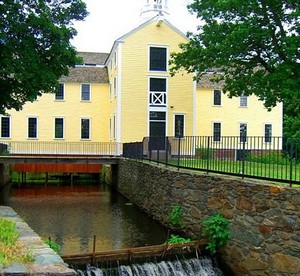
 A National Historic Landmark Site accredited by the American Association of Museums...
It’s no fabrication that Slater Mill of Pawtucket, RI, powered by the mighty Blackstone River, served as the first commercially successful water-powered, roller, cotton-spinning mill in America. Valiant efforts since the turn of the twentieth century to restore the structure to its former magnificence, have endowed the public with a living history museum and cultural center for Pawtucket.
Named 2009 Editors’ Choice for “Best History Escape” in Rhode Island by 'Yankee Magazine,' Slater Mill of Pawtucket looms prominently in the horizons of native Rhode Islanders and out-of-towners who seek a journey weaving through America’s Industrial Revolution. Tour guides in period costume spin local history threaded with innovation, labor (many workers were children), women’s rights, cotton economy, immigration, and assimilation.
In 1793, Samuel Slater founded Slater Mill, built along the Blackstone River, primarily owned by the prominent Brown family. Water power generated from the falls converted raw cotton into cloth.
The first commercially successful cotton-spinning mill still standing in America had been augmented with several additions between 1801 – 1834 and 1869 – 1872. The site was used as a spinning mill until 1895, and other industrial purposes until 1923. Efforts to restore Slater Mill into a museum resulted in a structure restored to its 1835 appearance which opened in 1955.
Restoration of the nearby Wilkinson Mill (1810 – 1811) was completed in 1973.
Tourists can feel the vibrations of the 16,000-pound mill wheel, a replica of the original that once harnessed the power of the Blackstone to make tools. The Sylvanus Brown House, built in 1758, was moved through the streets of Pawtucket in the 1970s to the current historic site as part of the museum complex. Here, one can witness firsthand how spinning, weaving, cooking and quilting ruled the day.
A National Historic Landmark Site, Slater Mill is accredited by the American Association of Museums, where at least 30,000 visitors per year, hailing from every state. People from over 150 countries have walked the beat along the scarred and pockmarked flooring of the mill. As if the exhibits, artifact collections, grounds, gallery, concerts, demonstrations, fine crafts and artwork aren’t enough—there is the unexplained paranormal phenomena as well.
The staff at Slater Mill now conducts special “ghost tours,” ending in the same location where an episode of 'Ghost Hunters' was filmed. Groups of ten or more may book a private tour throughout the year. Keep in mind, though no one has actually seen a ghost, members of The Atlantic Paranormal Society stated, and many have corroborated, there’s a feeling of a “presence” while walking amidst the old looms and spinning machinery, and a “tense” and “heavy vibe” given off to those who enter the machine shop in the Wilkinson Mill.
Slater Mill, the oldest, standing cotton mill in America, looms prominently in the birth of our nation as an industrialized society. A historical tour worth embarking on, expert commentary from costumed interpreters fosters our imagination to conjure the lives of the people – many of them children – who made Slater Mill pulsate with energy. It’s no fabrication that Slater Mill, a National Historic Landmark, is worth weaving your way through.
|
























I've only visited one mill, Jackson's Mill, Stonewall Jackson's family mill in West Virginia. The mill is gone and the site is now a West Virginia state historic camp.
Ron