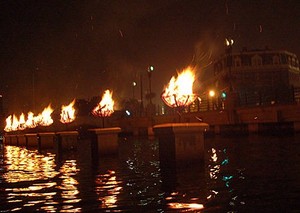
 Stroll along an illuminated riverwalk at Waterplace Park in Providence, the creative capital.
Once upon a time, Rhode Island's capital city of Providence had a sordid past due to its mighty muddy waters. The Providence River is an 8-mile tidal river formed by the confluence of the Woonasquatucket and Moshassuck Rivers in the downtown area. A half mile downstream it is joined from the east by the Seekonk River.
By 1830, extensive industrialization through the manufacture of metals, machinery, textiles, jewelry, and silverware polluted the waters which powered the factories. Prior to its facelift, Providence was a seedy waterfront mélange of asphalt, railroad tracks, freight yards, parking lots, roadways, and nine separate but interconnected bridges.
In 1979, consultants Skidmore, Owings, & Merrill, in conjunction with the Providence Foundation, concocted the Capital Center Plan for land owned by the city, state, Amtrak and P&W Railroad.
The grand plan specified setting aside fifteen parcels of land for commercial development which involved moving the rivers and railroad tracks, along with reconfiguring roads. A Waterfront Redevelopment Study for Providence was completed in 1983; an Environmental Impact Statement was ready by 1984. Funded by the city, state, and Federal Highway Administration, it took ten years to implement.
Just as Rome wasn't built in a day, the "Renaissance," nickname for the city's rebirth, afforded Memorial Boulevard charm tourists could not resist: 11 acres of urban riverfront parks and 1.5 miles of riverwalks to stroll for all seasons with no particular reason. In fact, 'The New York Times' cited Providence as "The Mecca of Tourism and Arts."
The wonder of it all, Waterplace Park:
A four-acre site in the heart of downtown Providence with an outdoor amphitheater surrounding a cove, Venetian-inspired bridges, cobblestone walkways, pavilions, sculptures, and fountains. The location hosts many live theater productions and festivals. Visitors may canoe, kayak, or ferry in a gondola via accessible boat landings along the riverwalk. An added feature to an already spectacular Waterplace experience is the nationally and internationally renowned WaterFire.
WaterFire, symbol of Providence's renaissance, is a sculpture designed by Barnaby Evans, and installed on the three rivers. Illumination from one hundred bonfires reflects off the bridges, torch-lit water craft, and physical movements of the fire tenders. To commemorate milestone events in the capital city, Evans created First Fire in 1994 and Second Fire in 1996.
Enthusiasts convinced the sculptor to create an on-going fire installation which is funded by corporate donors, sponsors, and visitor contributions.
By 1999, one hundred bonfires prevailed. A plethora of volunteers devote hours to create the sparkle and enchantment of WaterFire for an adoring public. As the lighting season typically runs from March-October, announcements are made on the website and in the local newspaper to indicate where a partial or full lighting will take place along the riverwalk.
Whether you fancy a brisk fitness walk or leisurely stroll along the cobblestone paths of Providence's Waterplace Park, the scenic view of the downtown area makes it all worthwhile.
Seasonally permitted, grab a spot in the outdoor amphitheater to witness WaterFire for free. Reconfiguration and movement of a river was one grandiose gesture of hospitality to assure a moving experience for all who visit the Renaissance City aka The Creative Capital.
|




















Sears, Kmart and Walmart have all done their part in moving commerce away from city centers to the suburbs leaving the polluted byways and waterways to deteriorate further. So these inner-city efforts to clean up and spruce up are very welcome. Perhaps the most famous of these is San Antonio's Riverwalk. Houston is trying to do that and has the money to do it big.
The idea of a fire walk is both enlightening and disarming. I first remember seeing something like that in Yosemite with the nightly fire fall. Every night, a bonfire was built at the crest of Half Dome, I believe, and bulldozers would push the embers off the edge creating a beautiful, fiery waterfall down the face of the monolith to be seen by everyone in Yosemite Valley below. That practice was stopped in the early 1970s because it was quite destructive to the environment, burning all that wood and creating all that toxic smoke (because of campfires, sometimes Yosemite Valley had its own form of smog.)
Ron