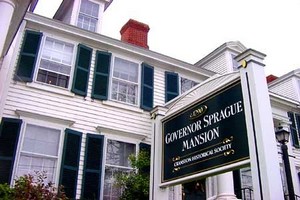
 Earning the reputation of being one of America’s most haunted mansions...
While several Rhode Island mansions lure residents and out-of-towners to tour their confines for the architectural marvel of the Gilded Age, Governor Sprague Mansion of Cranston compels us to step over the threshold to channel the tragedy which befell one of its occupants. The progression of events spawned a travesty of justice which continues to haunt Rhode Islanders till this day, giving pause for former Governor Lincoln Chafee to ponder and pardon. The lure of the lore is interwoven between the mansion and the family’s prominent and prosperous cotton printing plant.
The Homestead:
Birthplace of two Rhode Island governors, the Governor Sprague Mansion on 1351 Cranston St. in Cranston, RI, exemplifies the prosperity of its former residents. The original twenty-eight room, 2 ½ story, 5-bay, gable-roofed abode was built in 1790. Early construction of a simple homestead revealed a central chimney, low ceilings, and simple woodwork. As the family acquired greater wealth, many changes were wrought by 1864 with the addition of a new section.
Stepping inside the home today, we’d note a wide hall lighted by a fan-shaped window above the entrance door. The woodwork and railings are decoratively carved. The mantles of the fireplace are made of Italian marble. According to the Cranston Historical Society which acquired the mansion in 1967, the most striking feature is the cupola atop the new section of the homestead.
“From here the Spragues viewed their panorama of Cranston holdings-- the orchards, vineyards, woodlands, reservoir, railroad, horse car company, Cranston Print Works, its two villages of mill houses complete with a school, community store, boarding houses, meeting house, post office, and counting house sometimes called the Cranston Bank.”
Tours may be arranged through the Cranston Historical Society by appointment.
Cranston Print Works:
Established in 1807, originally called, “Sprague Print Works,” William Senior converted the gristmill on the banks of the Pocasset River into a small cotton mill for carding and spinning yarn. Eventually, he and son, William II, installed water-driven power looms on a large scale which lowered production costs and increased output—one of the hallmarks for a thriving business. The Spragues were also the first entrepreneurs in the country to print calico.
Brothers Amasa and Will II took over the biz after the death of their father in 1836. Though both brothers were active in politics, Amasa took over the lion’s share of running the Print Works. William II served in the capacity of state representative, governor, and lastly-- US senator. He resigned to manage the company after Amasa’s murder, an atrocity which continues to haunt Rhode Island today.
History in the Making:
On New Year's Eve day of 1843, Amasa Sprague's bludgeoned body was found in the snow along the road outside the Cranston mansion. The Gordons, Irish immigrants, who owned a liquor store, came under suspicion as Amasa Sprague appealed to the city council to revoke their liquor license, presumably because it irked him that his employees frequented the store during lunch hour and returned to work at the mill drunk. Authorities felt the license revocation established motive.
Purportedly, the police arrested every one of the Gordon family including the elderly mother and the dog. The state trial commenced in 1844 during a time of prejudice against Irish Roman Catholics, a new wave of immigrants constituting a perceived threat against the reigning Yankee Protestants.
The trial of brothers William and John Gordon proceeded with scant circumstantial evidence: coat, broken rifle, and footprint in the snow; William had an alibi whereas John did not. Over the course of nine days, 102 witnesses gave confusing and contradictory testimonies. The presiding judge instructed the jury comprised of Yankee males to give greater credence to Yankee witnesses rather than Irish. After deliberating for 75 minutes, the jury acquitted William and convicted John of murder.
Another jury came back hung at Nicholas’ trial. Though John’s second trial was scheduled after his execution date, an appeal for postponement was denied. John Gordon was hanged on February 14, 1845, the last person to receive the death penalty in Rhode Island. Capital punishment was abolished in 1852.
In hindsight, this travesty of justice which resulted in a wrongful hanging has tormented Rhode Island for years. A state lawmaker sponsored a measure calling for the governor to posthumously pardon John Gordon for the murder of industrialist Amasa Sprague.
The Sprague Mansion has earned the reputation of being one of America’s most haunted mansions. Accounts of blankets pulled off beds, the sound of footsteps, lights going on and off by themselves, and dolls moving on their own in the “Doll Room” have spooked those who’ve crossed the Sprague’s threshold. An investigation conducted by 'Ghost Hunters' also disclosed strange occurrences.
The most haunting phenomena of all is that of the hanging of a man whose noose was tightened by an unfair judicial trial, stirring public indignation as to legislate the abolition of capital punishment in the state of “Rhode Island and Providence Plantations.” The Spragues may be the most renowned historical family in the city of Cranston for their vast accumulation of wealth, power, and influence stemming from textile manufacturing. However, the view from the cupola atop the mansion is overshadowed by the murder of Amasa Sprague and its shameful aftermath.
|




















Wayne
The closest I ever came to a haunted mansion was to drive by San Jose's famous Winchester House. A poor student at the time, I wasn't willing to pay the admission price to find out how many never-ending, ending staircases there were in the place. On a dark night, the concrete deer in the yard appeared white and ghostly against the darkness of the mansion.
Ron