 Accessories after the fact, hats put a feather in our cap or pull the wool over our eyes!
Long before John-n-n-n-y plunged into the Depp-th of a rabbit hole and tunneled his way to Wonderland, mad hatters have mattered as a matter of fact! Pulling rabbits out of hats, their madcap fantasies transformed fabrics and frills into heady wear for women during the Sixties: fedoras, berets, newsboy caps, toques, and trilbys.
Accessories after the fact: dress, shoes, white gloves, and handbag—hats put a feather in our cap or pull the wool over our eyes.
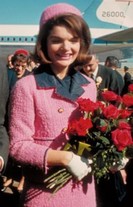
Blazing brimrod, haberdashery and millinery fashion trails through the Sixties was a mad hatter named Halston who designed hats for Manhattan’s Bergdoff Goodman department store. Halston designed a pillbox hat made famous because of the head it would rest on. Jacqueline, before the O, Bouvier Kennedy, wore a simple, unadorned bone-colored, wool pillbox hat at JFK’s presidential inauguration in 1961.
So smitten with Halston’s design, the pillbox became the former first lady’s trademark. She wore a pink one on the day her husband was shot on November 22, 1963. The tragic reminder of our 35th president’s assassination triggered a sharp down-turn for the reign of the pillbox.
Revered for her charm, glamour, and trendsetting styles, American women emulated JBK’s signature pillbox hats. When she accidentally dented a pillbox hat, similar ones with dents surfaced everywhere. This smallish, brimless, round hat characterized by simplicity and elegance, featured straight sides and a level top. They most often came in solid colors and were usually unadorned except for a net veil, single pin, or jewel. Made from an array of fabrics, one could turn heads in wool, velvet, mink, lynx, fox, or leopard skin.
In fact Bob Dylan, a mad hatter in his own right, composed a song about a jilted lover—“Leopard-Skin Pillbox Hat” (1966).
Other mad hats of the Sixties you’ll need to rely on your memory for, or power of envisioning to appreciate, included:
Newsboy Cap - Rendered popular by the Beatles, this cap had a strap above the bill with a button on each side and was made of corduroy, velvet, leather, or wool. Great for day trippin’ – yeah, yeah, yeah!
Fedora – Think Bud Baxter (Jack Lemmon), a struggling clerk in a New York insurance company, discovering a quick way to climb the corporate ladder ('The Apartment,' 1960). Not surprising, the fedora went out of style during the latter part of the Sixties decade.
Beret – Black ones became associated with the Beatnik culture of the 60s. I also associate them with the cool kids in high school who hung on the street corners downtown where the neon signs are pretty.
“Green Berets” was the nickname for the US Army’s Special Forces associated with exploits in Vietnam, commemorated by Sergeant Barry Sadler’s “The Ballad of The Green Berets” (1966).
Trilby – Mostly worn by men, this style of headwear resembling the fedora, featured a small brim that creased a little in the front and turned up in the back. This style reached the height of popularity in the 60s, favored by jazz and soul musicians tooting their own horns.
As hairdos ballooned into complex beehives by 1969, most women’s hat styles went out of fashion. Although, long straight hair styles worn by Hippies resurrected the popularity of the floppy leather hat. Various floppies also became stylish headwear for the ladies who dressed “mod.”
No occasion was finer than an early Sixties Easter Sunday morning to get all dolled up for going to church accessorized with white kid gloves, patent leather shoes, matching handbag, bonnet, and corsage. Trimmed to the brim, we filed into a church pew, nodding and bobbing our heads in greeting to other parishioners without exchanging words.
Great hats speak for themselves!
|






You mentioned mad hatters briefly. There is truth to the Alice in Wonderland character. During that era, mercury was used to make hats in the factories in England. The resulting mercury poisoning affected many of the workers. Unable to diagnose the malady correctly, they were described as, "going mad."
My father wore a fedora on Sundays and a cap the rest of the time in the winter. As a truck driver, I recall a Jackie Gleason Honeymooners style green cap as part of his company uniform. My mother only wore a hat on Sundays and special occasions and always wore a very modest one that didn't completely cover her beautiful hair. My brother and I eskewed hats, T-shirts, and long underwear as being passé. As a result, suffered some trauma on cold winter below zero days with only sweaters boots and heavy coats for protection. I recall leaving the house right after a shower and having my hair frozen very shortly. Earmuffs were applied whenever my ears indicated that frostbite was eminent.
I see that you are fond of from your pictures here. Some girls are prettier with a bonnet on it. ;-)
Ron