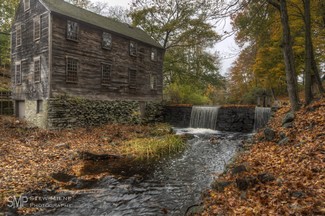
 The Moffett Mill is believed to be the first machine shop in Rhode Island!
Moffett Mill
Situated along the Great Road Historic District in Lincoln, Rhode Island, the Moffett Mill rests on the laurels of the Moshassuck River. Built by George Olney in 1812, the Moffett is one survivor worth milling around in, by George!
By 1683, Great Road of Lincoln, Rhode Island became the major thoroughfare on the west side of the Blackstone River. Inside the beltway of Great Road’s Historic District, distinguished houses, farms, and mills retain much of Blackstone Valley’s early nineteenth century character.
The two-story building known as Moffett Mill constitutes a rare example of a wooden mill built during the first wave of industrialization in the Blackstone Valley region.
No less significant, the Moffett is believed to be the first machine shop in Rhode Island! Arnold Moffett purchased the property in 1850 and built the stone dam which still stands.
Powering the mini but mighty Moffett in its heyday, the Moshassuck River whose Native American Indian name means “river where moose watered,” deserves much credit for the mill’s versatile production of goods. Considered a special order job shop, its workers made parts for ships, machines for the early textile industry, furniture, wagons, carriages, and sleighs.
The second floor once hosted a fleet of braiding machines to make shoe and corset laces.
An attached lean-to once housed a blacksmith shop which expanded the Moffett’s operations in woodworking and metal crafting to make wheels.
As important as the Moshassuck River was for the Moffett Mill to carry on its functions, by mid-nineteenth century, pollution of the river from so many factories dumping industrial and human waste into its waters, shouldered the blame for Rhode Island’s cholera outbreaks in 1849 and 1854.
Though abandoned since the early part of the 1900s, Moffett Mill was donated to the Town of Lincoln in the 1980s. In 2000, it was reasonably restored with its original equipment still intact.
While not a working mill, and due to its extremely close proximity to the road, one must schedule a private tour. An interpretive panel located outside the building will help to inform visitors as to its socio-economic importance. Whenever I drive by it, I can't help noticing how rickety it appears, and wouldn't set foot inside.
As long as you’re milling about The Moffett, don’t rest on your laurels. There are several other distinguished sites along Great Road in Lincoln where 300 years of history can be found within 3 miles - perfect for a leisurely drive by or visit, if scheduling allows. One of these, I’ve written about and published at Authors Den—“Rhode Read: RI Mansion Built on Lottery Wins & Heartbreak”:
http://www.authorsden.com/visit/viewarticle.asp?AuthorID=65583&id=74939
Other Great Road greats can be glimpsed here:
http://www.woonsocket.org/greatroad.html
|


























enjoyed your interesting, informative article
always like to learn more of the early days and activities of our country
well done, plan to save the article
m
In Wisconsin there are also historical locations. As a child I explored some early companies that were no longer in business and falling in ruin. Later as a college student of technology and even later as a professor of the same, I toured many historical companies and was amazed to find that some machinery was still operating over 100 years since the time it was installed.
Rivers like the Moshassuck always appealed to me for their rustic beauty. But you pointed out the downside of those rivers when they were overused for industry and massively polluted. I feel good that many of those rivers have been restored and I once again beautiful.
On a TV show recently, I saw a wooden wagon wheel being repaired by hand. It's amazing the skill that went into making the millions of wagon wheels of wood and iron that that rolled industrial progress in the 19th century.
Ron