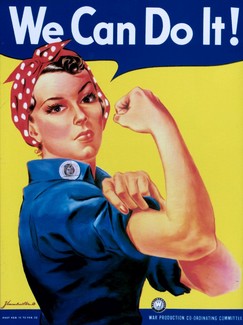
 Riveting Rosies gave birth to a generation of Baby Boomers riveted with a rebellious attitude.
The Feminist Movement can thank Rosie the Riveter for flexing her muscles as a show of strength and independence to empower women. While the men went off to fight the battles of WWII, these women carried our nation on their backs making a contribution to the war effort by working in factories. When their Johnnies came marching back home after the war, these same gals resumed their traditional roles of homemaker and motherhood, giving birth to a generation of Baby Boomers riveted with a rebellious attitude.
Since the Sixties were a prime time of protest against the Vietnam War, and avocation of equal rights be they Gay, Student, or Civil--why not equality for women while we were at it?
Empowered Daughters of the Riveters revolted against male supremacy in a capitalistic society where discrimination in wages and promotions ran rampant. I never aspired to climbing the corporate ladder, but the view from the community college rooftop onto the grassy knoll encompassed a narrow sexist strait predominated by teaching, nursing, or social work.
I doubt our riveting Rosies in their oversized dungarees were ever accused of being a sex symbol while earning a day's wages. Yet, their Sixties Chicks daughters, many of whom went braless and wore see-through blouses and miniskirts, still wanted to be taken seriously on the job.
As Betty Rollin put it, "Scratch most feminists and underneath there is a woman who longs to be a sex object. The difference is-- that is not all she wants to be."
|


























Love the quote!
Sandie
There has been some discussion that the typewriter first enabled women to work. Apparently men found the newfangled device difficult to master and encouraged women to take up typing. But most of them were spinsters, because typists probably were considered to be unattractive housemates.
Before the electric starter was invented and placed in automobiles, very few women drove cars because cranking them to start was difficult and could break your arm. Around 1910 when cars started getting electric starters, women started driving.
Finally, it is also said that the telephone helped to get women work. For some reason, probably gossip, most telephone operators on local exchanges were women. A more pleasant voice and more tolerance of what was overheard on the lines was probably why women were on that job. ;-)
I sure hope Betty Rollin's statement is true!
Ron