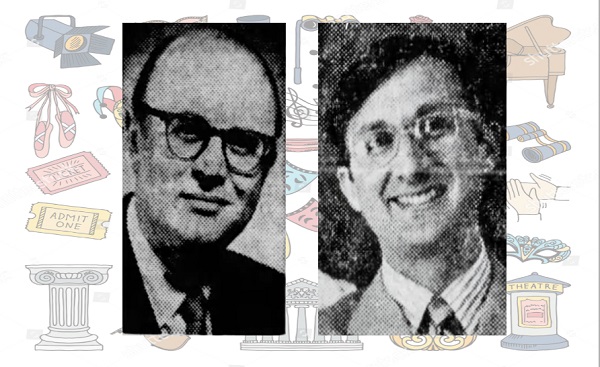
 The public feud between Craig Gilborn and Otto Dekom in late '60s and '70s Delaware reveals larger debates on federal arts funding and the tension between local and national artistic influence.
The late '60s and early '70s served up a very public feud between Craig A. Gilborn, the then-executive director of the Delaware State Arts Council, and Otto Dekom, a prominent newspaper critic, over how Delaware should best allocate federal arts funding.
The tense back and forth reflected wider national discussions sparked by the 1965 establishment of the National Endowment for the Arts.
Evan H. Turner, then-director of the Philadelphia Museum of Art, lauded the Delaware State Arts Council's creation in a 1969 editorial, echoing President Johnson's belief in art as a societal cornerstone.
In this climate of optimism, the verbal fisticuffs between Craig Gilborn and Otto Dekom emerged as natural growing pains—complex realities that accompanied the fulfillment of a larger vision, rather than indicative of systemic failure.
Gilborn, the Arts Council's inaugural executive director, leveraged his Virginia Museum of Fine Arts experience to prioritize local talent, stating it formed the 'bedrock of any thriving arts scene.'
A respected newspaper columnist by 1969, Otto Dekom leveraged his background in economics, political science, and public relations to critique Delaware's arts landscape.
Dekom was vocally skeptical about Gilborn's leadership. He minced no words when he declared, “Gilborn has put a ceiling on our culture future by favoring local amateur groups over professional ones.”
Differences in age and cultural background colored the perspectives of both men, lending weight to their evaluations of Delaware's arts and culture. Gilborn, at 34, was navigating the early stages of his career, while Dekom, 51, had already cemented a reputation for strong views, influenced in part by his native Romanian heritage.
Their ideologies clashed in a very public manner. Dekom accused Gilborn of fostering a provincial mindset, of being content with what he saw as cultural mediocrity. "Such a performance may be entertaining, but it is no meaningful contribution to the state's cultural stock," Dekom remarked about Gilborn’s focus on amateur art forms like jazz concerts.
Columnist Bill Frank defended Dekom, emphasizing the constructive nature of his reviews.
Gilborn highlighted the Council's financial struggles, exacerbated by inadequate support from local entities.
Even as he championed the nurturing of local talent, Gilborn implemented initiatives aimed at broadening the Council's program. He described how expectations of a cultural renaissance "overnight are naive" and argued that the Council's responsibilities transcended merely showcasing established excellence.
Dekom for his part denounced Gilborn's hesitance to invite professional musicians, suggesting that this approach leaves Delaware "in the backwash of the great cultural wave." He expressed disappointment that the Arts Council had not made significant cultural contributions, despite having already spent a large portion of its budget.
The ideological tug-of-war between Gilborn and Dekom was emblematic of broader cultural debates. While Gilborn viewed Delaware as an incubator for grassroots cultural development, Dekom insisted on a more cosmopolitan approach, favoring the importation of established works and artists.
Less than seven months before Craig Gilborn's departure as the first Executive Director of the Delaware State Arts Council, Otto Dekom continued his unrelenting scrutiny of Gilborn's tenure. In an October 1971 ‘Morning News’ column, Dekom lambasted the cancellation of the customary pre-concert cocktail party and dinner held before Delaware Symphony concerts.
Dekom set Gilborn in stark contrast to previous speakers, such as William Smith, the assistant conductor of the Philadelphia Orchestra, and Michael Straight, an author and former editor of 'The New Republic.' He praised these earlier speakers for their oratory prowess. Meanwhile, he bluntly stated that Gilborn—"whatever his erudition—is not a great speaker."
Dekom further argued that Gilborn's planned appearance led to the disappointing attendance numbers and eventual cancellation of the event. The council, under Gilborn, had supported the Delaware Symphony for two consecutive seasons, but Dekom implied that Gilborn's lack of public speaking skill could undermine even financial contributions.
Craig Gilborn lasted three years in the hot seat. In June 1972 he headed to Blue Mountain Lake, NY to become director of the Adirondack Museum, where he stayed to finish out his career. Gilborn's exit interview brought a form of closure to his and Dekom’s public spat. He chose not to engage directly with the latter’s criticisms, a dignified silence that spoke volumes.
Gilborn, instead, left with a call to action for increased public and corporate support for the arts. “The once-popular notion that wealthy benefactors could single-handedly sustain the arts in Delaware has faded into myth,” he said. Gilborn suggested that the Delaware State Arts Council should consider branching into environmental issues, touching on topics like billboards and high-rise power lines that affect the state's aesthetics.
Otto Dekom continued as a critic at the ‘Morning News’ until his 1983 retirement. He was more known from 1972 onwards as a food critic.
The vitriol between Gilborn and Dekom underscores the Gordian Knot dilemmas federal arts funding provokes. Communities are forced to make intricate tightrope-walking decisions when reconciling local and global artistic influences.
|










While I immediately thought of visual arts in museums, your article focused primarily on the local debate between a columnist and the executive director of the Delaware Arts Council. While you didn't directly state it, the musical debate may have been similar to my debate with my father over rock 'n' roll versus the more traditional crooners and big band music.
But at the time, it may have been about what is known as the British Invasion, started by the Beatles in 1963. I recall in the fall of 1974, some undergraduate coeds at Marshall University where I was teaching business courses, Little Girl Productions, brought Pink Floyd, before unknown to me, to Huntington West Virginia, I'm sure shocking the local arts establishment in a town based on old Virginia charm and attitude.
Art has always been the pet project of the wealthy. But many famous artists have not become famous until after they died when their art became nearly priceless because of the battle of wealthy purchasers or museums wishing to have artwork. While that same artwork was initially sold or given away by the originator for a pittance. Hence the necessary need to support artists prior to their becoming famous because one does not know what the taste of the wealthy will be in the future. The very reason why this country is having strikes over screenwriting and acting today. The creators of the content are grossly underpaid while owners of the content receive billions in fan approval.
Ron