 Delaware's holly wreath industry, born in the 1880s, brought Christmas cheer and economic prosperity to the state for decades before declining in the 1960s due to modernization.
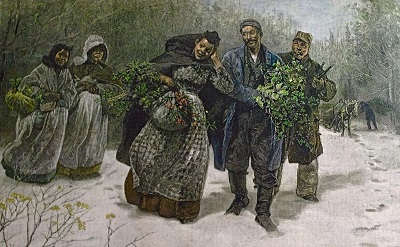
In the late 19th and early 20th centuries, the humble American holly tree became the cornerstone of a thriving holiday industry that would keep the Christmas spirit alive in Delaware for decades. This evergreen, with its glossy leaves and bright red berries, transformed southern Delaware into an economic powerhouse, earning it the nickname, 'Land of Holly.' For nearly 60 years, Delaware's abundance of Ilex opaca Aiton, also known as Christmas holly, fueled a major export industry that brought both cheer and prosperity to the region.
The story of Delaware's holly wreath industry began in the 1880s when John T. Watson, a Sussex County native, conceived the idea of using holly as a Christmas greeting. As reported in the Smyrna Times on December 19, 1946, "John T. Watson, about 60 years ago, began sending to his friends, as his Christmas greetings to them, a package filled with berried sprays of the beautiful evergreen holly that grew in comparative abundance in the woodlands of the state, particularly in the vicinity of his native Sussex County." This simple act of generosity laid the foundation that eventually grew into a booming commercial venture.
By the 1890s, the holly wreath industry was already making a significant impact on the local economy. The Milford Chronicle reported on December 22, 1893, "The industry of making holly wreaths has been quite a source of revenue to the many employed therein." This sentiment was echoed two years later in the Middletown Transcript on December 21, 1895: "'Trimming up for Christmas' becomes a more popular custom every year, so much so that the holly wreath, crowfoot, laurel and pine bough are as necessary as 'the stocking hung by tie chimney with care.'"
Henry and Eunice Burton, proprietors of a downtown general store, established the holly wreath business in Milton. As Allison Schell, Executive Director of the Milton Historical Society, explained to the News Journal in 2014, "Just before the holidays, local farmers would bring in holly wreaths as payment and, in turn, Henry would send the wreaths to city merchants, along with other goods he traded for merchandise." This simple barter system soon evolved into a more formal business structure.
As the demand for holly wreaths grew, so did the industry. The Burton Evergreen Company, established by Henry Burton, began purchasing and reselling the natural, locally made holly wreaths every year. The enterprise expanded significantly in 1904 after Charles G. Jones Sr., a Milton fertilizer salesman, married the Burtons' daughter, Virginia. Jones left his sales career to help the family expand their holly wreath business, focusing on acquiring superior quality wreaths from the Sussex countryside.
Jones, The Holly Wreath Man, started small but grew rapidly. In their first year of expansion, they invested $50 in stamps to send out advertising material—a sum that caused concern for Jones' wife about their return on investment. However, her concerns were quickly assuaged when their holiday season profit reached $360.
Communities across Delaware and the Eastern Shore of Maryland embraced this seasonal business opportunity. The Smyrna Times reported on December 5, 1928, "Manufacture of holly wreaths started this week in a score of communities in Delaware and over on the Eastern Shore of Maryland. Many hands are busily engaged in fashioning Christmas greens for shipment to large nearby cities, as well as for house to house sale." The same article highlighted the economic impact of the industry: "From three to ten cents is usually paid for making wreaths, and one Maryland dealer avers he paid out $30,000 last year for the manufacture of holly wreaths." This substantial sum underscores the significance of the holly wreath business to the local economy.
The industry provided a crucial source of income for many families in Sussex County, particularly during the holiday season. The Milford Chronicle reported on December 11, 1931, "Several thousand dollars will be paid out by local dealers for this labor which will be used in the purchase of warm clothes for each member of the family and the purchase of Christmas gifts." In some cases, families were able to earn substantial sums during the short holly season. The same newspaper noted on November 25, 1932, that "a family of four, in the two or three weeks while the season lasts, have been known to make as much as five hundred to a thousand dollars, and several have purchased homes and paid for them from the receipts from making holly wreaths."
As early as 1905, concerns about the sustainability of holly harvesting led to legislation. The Milford Chronicle reported on November 24, 1905, "At the last session of the Delaware Legislature there was an act passed making a fine of $50 and two month's imprisonment for breaking or cutting a single twig of holly or evergreens without permission by the owners of same." The law was partly created in response to the anger of farmers whose land was being trampled by holly gatherers. This tension is evident in a report from the Evening Journal on November 14, 1911: "When women and children can make as high as $300 in six weeks before Christmas making holly wreaths, no wonder that growers of land on which holly grows are banding together for mutual protection against holly thieves this year." The frustration of landowners is further illustrated by a representative classified ad posted by one H. Studte of Houston, Delaware, in the Milford Chronicle on November 29, 1912: "WARNING—Positively no trespassing on my Farm, or no holly stealing from my Farm. I will prosecute every trespasser."
W. S. Taber, Delaware State Forester from 1927-1941, highlighted the economic importance of the holly industry to the local community. In a statement reported in the Milford Chronicle on December 26, 1930, Taber explained: "In the lower section of the State where the holly and Christmas greens are found most plentiful, the manufacture and sale of holly wreaths and other Christmas greens provide employment for hundreds of poor people. The total funds they receive from the sale of these forest products amounts to close to $400,000. It is their honestly earned Christmas present." Taber further elaborated on the necessity of the protection law: "It seems that people who are otherwise law abiding have no conscientious scruple about taking branches of holly or cutting Christmas trees from another's property. This is perhaps due to the persistence of a medieval belief that Christmas decorations were plentiful and easily obtainable, hence, of no value. Nothing could be further from the truth at the present time."
The onset of the Great Depression hit the holly wreath industry hard, illustrating the vulnerability of this seasonal business to broader economic trends. The Milford Chronicle, in its November 25, 1932 issue, painted a stark picture of the situation: "The last two years have not been as prosperous with the makers as heretofore, owing to the depression existing. When business is good and people employed, everyone decorates their homes at Christmas tide with holly wreaths and holly branches, but now under the existing circumstances they have to let the decorations go and use the money---if they have any---for the purchase of something to eat." This stark reminder of the economic challenges underscores how deeply intertwined the holly wreath industry was with the well-being of Sussex County's residents. What had once been a source of supplemental income, even prosperity, for many families had become, in the depths of the Depression, a tenuous lifeline that was itself under threat.
Despite these challenges, the holly wreath industry demonstrated remarkable resilience. Innovations in preservation techniques allowed for earlier harvesting and longer-lasting products. The use of artificial berries became increasingly common, especially in years when natural berries were scarce. As reported in the Milford Chronicle on December 2, 1927, "While there is an abundance of green holly for wrapping there is a scarcity of holly berries and dealers are compelled to furnish the wrappers with artificial berries."
The importance of the American holly to Delaware was officially recognized on May 1, 1939, when the state's General Assembly designated it as the State Tree. Delaware schoolchildren chose from several options, including oak and pine, with the American holly emerging as the winner. This decision made Delaware the only state to select the American holly as its State Tree.
The holly wreath industry peaked in the mid-20th century. This zenith was the result of several converging factors. The post-World War II economic boom led to increased consumer spending, with many Americans having more disposable income to spend on holiday decorations. Improved transportation networks made it easier to ship wreaths to distant markets, expanding the industry's reach. Additionally, the rise of suburban living and the increasing popularity of elaborate holiday home decorations created a surge in demand for traditional Christmas greenery. The industry had also refined its production and preservation techniques over the decades, allowing for higher quality products and longer shelf life. Furthermore, the holly wreath had become firmly established as a quintessential American Christmas decoration, partly due to marketing efforts and partly due to its long-standing cultural significance. All these factors combined to create a golden age for Delaware's holly wreath industry.
In 1951, at the height of this boom, "Jones, The Holly Wreath Man" and company achieved a remarkable feat when they were commissioned to produce an 11.5-foot wreath to hang in New York City's Rockefeller Center. As Allison Schell of the Milton Historical Society noted, "It was considered the largest handmade wreath in the world at the time." This high-profile commission not only showcased the skill of Delaware's wreath makers but also symbolized the industry's prominence on the national stage.
Natural disasters posed ongoing threats to the holly crop. On December 10, 1954, The Milford Chronicle reported on the impact of a drought and Hurricane Hazel: 'The hurricane divested the trees of their berries, which eliminated the holly sprigs for this year, and it caused leaves to lose their color.' But there was ample left in the way of twigs and their leaves for the county's growers to meet their share of the demand."
However, the industry faced additional, unsolvable challenges in the post-war era. By the late 1940s, entire plastic holly wreaths had entered the market. The plastics industry also pushed box and crate manufacturers to a low production point, as they could not compete with the cheaper, stronger, and more attractive packages.
Uncle Sam added another nail to the coffin. In 1956, a special ruling from the U.S. Department of Labor declared that people who made wreaths in their homes were subject to the $1/hour minimum wage under the Fair Labor Standards Act. (Dealers had previously paid per wreath.) Although Delaware's holly wreath dealers and makers pressed for an exemption, it was denied. The increasing use of artificial goods and the wage law requirements affecting piecework businesses led to the rapid decline and eventual end of the industry by the 1960s.
Holly's cultural significance extends far beyond its economic impact. Its history can be traced back 2,000 years to ancient Britain and France, where it held a special place in Druid traditions. The Druids, who formed the priestly class in ancient Celtic societies, considered holly to have magical and protective properties, especially during the bleak winter solstice. As Christianity gradually replaced these ancient religions, holly maintained its association with goodness and became an integral part of Christmas celebrations.
Today, the memory of Delaware's holly wreath industry lives on. Milton celebrates its festive foliage history each December with the Holly Festival, featuring wreath-making demonstrations sponsored by the Milton Historical Society Museum.
From its humble beginnings with John T. Watson's Christmas greetings to its peak as a major export industry, the holly wreath business of southern Delaware embodies the entrepreneurial spirit and resourcefulness that has long characterized the First State. As we hang holly wreaths on our doors each Christmas, we're not just decorating our homes – we're participating in a tradition that has brought both economic prosperity and holiday cheer to generations of Delawareans.
|