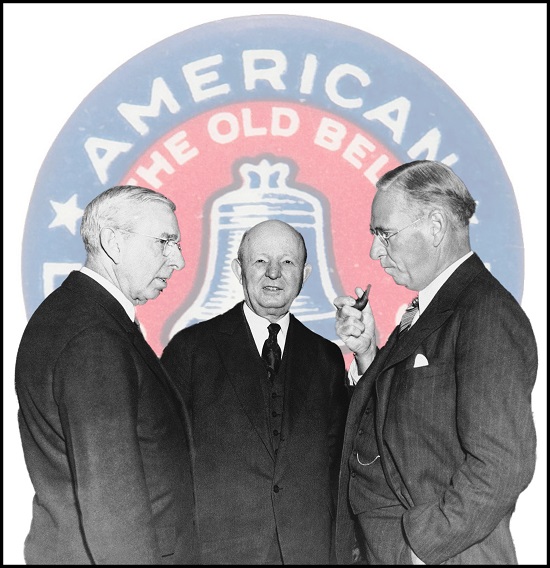
 FDR's Social Security Act faces firm opposition from business elite, igniting a historic debate on federal intervention.
The Great Depression swirled through the mid-1930s, bringing both personal and political unrest. The tempest blew right through the halls of Congress. In 1934, President Franklin D. Roosevelt sought to alleviate these miseries with a proposed Social Security Act. His legislation promised unemployment and disability insurance, plus economic security in old age. The business community pushed back immediately. They assembled an organized voice of dissent that aimed to counteract FDR’s ever-expanding programs.
Dissent Emerges
The American Liberty League saw the New Deal as a perilous journey towards socialism, bankruptcy, and dictatorship. The League stated it would “defend and uphold the Constitution” and “foster the right to work, earn, save, and acquire property.”
This group, comprised of corporate leaders from the likes of U.S. Steel, General Motors, and Standard Oil, vehemently opposed the Social Security Act of 1935.
One name stood out among the ranks of the League’s founders: Irenee du Pont, whose money largely bankrolled the group. The former president of the DuPont company championed the League’s mission as an affirmation of his own deep-seated conservative beliefs and commitment to laissez-faire economic principles.
“The federal government’s present methods of doling out other people’s money for relief are in direct violation of the Constitution,” he charged in an October 1934 interview. Du Pont campaigned fervently against the idea of wealth redistribution.
Irenee du Pont and the League, both firm believers in the sanctity of private industry and Constitutional government, saw the Social Security Act as federal overreach. They held that such programs should remain within the purview of state governments.
Furthermore, the League argued against mandatory employer funding contributions. They believed that such contributions would impose an excessive burden on businesses, hinder economic growth, and interfere with the principles of individual liberty and most of all free enterprise. Instead, they advocated for a voluntary system or ‘alternative approaches’ to address the social insecurity of the time.
Formed in August 1934 at a private meeting in New York’s Union League Club, the League’s high-powered corporate members together held around $40 billion in assets ($778 billion today.) These financial juggernauts used their resources to disseminate their beliefs through various media.
Beyond Social Security
The League’s opposition was not limited to Social Security. They stood against FDR on every front. The ALA’s view of the Agricultural Adjustment Administration, for example, was representative: “a vicious combination of Fascism, Socialism, and Communism which cannot be harmonized with the basic principles of Constitutional government in the United States.” The organization’s literature brimmed with a distinctive purple prose— “Work relief: a record of the tragic failure of the costliest governmental experiment in all world history.”
The Liberty League grew within two years to a sizeable 25,000 members. They had support from both the U.S. Chamber of Commerce and National Association of Manufacturers. Yet despite these advantages, the League’s message struggled to find a broad audience. By election day 1936, the organization’s backing of Republican candidate Alfred Landon hardly impacted public opinion.
Roosevelt rode back into office in a landslide victory. Only Maine & Vermont embraced Landon. The public had resoundingly affirmed FDR’s New Deal policies. Following this humiliating defeat, the League quietly retreated from public policy debate, folding entirely in 1940.
The American Liberty League did leave one lasting legacy. The group became the prototype for later Constitutional nationalist movements, from the John Birch Society in the 1950s to the Tea Party movement of the 2000s. Each subsequent wave echoed the League’s central goal – a return to what they identified as the nation’s true Constitutional values, rejecting all else as dangerously foreign.
|



















Since the 1980s, the Republican plan has been to reverse FDR's programs. Perhaps the most dramatic, was the repeal of the inheritance tax. Allowing wealthy dynasties to grow their wealth each generation. And when faced with the pandemic, president Donald Trump gave away more of the taxpayer money to the wealthy, proportionately, than he gave to the working people of the country out of their jobs.
Ron