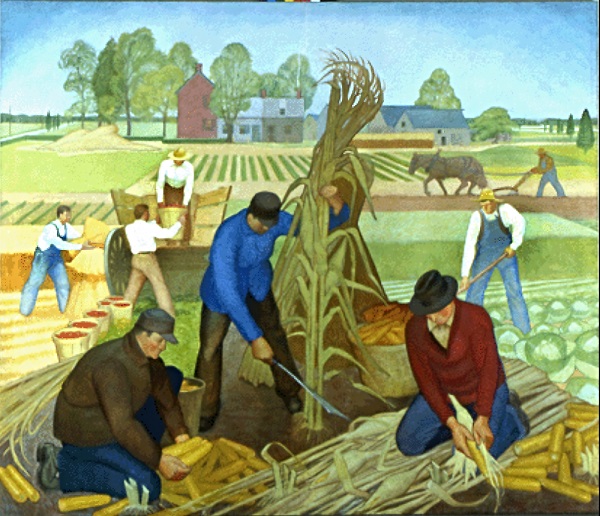
1939 marked Delaware's artistic zenith under the Federal Art Project: murals, public dialogues, and a vibrant community engagement.
The year 1939 marks a notable period in Delaware art history, owing to the remarkable achievements under the Federal Art Project (FAP). This twelve-month period also represented the zenith of the agency’s influence and success.
The FAP, active from 1935 to 1943 as part of Franklin D. Roosevelt’s Works Progress Administration, played a pivotal role in providing employment for artists during the Great Depression.
Notable Artworks and Artists
The arts group led to the creation of murals, sculptures, paintings, and more in Delaware. Murals by Edward L. Grant, Walter Pyle, and Andrew Doragh found their way to the walls of Georgetown High School, Claymont High School displayed Walter Pyle’s “History of Claymont” mural, Howard High School hung Edward Loper’s newly created paintings, and Smyrna High School featured six murals, by Edward L. Grant, Walter Pyle, and Stafford Good, including the latter’s “Cavalcade of Delaware.”
Jeannette Eckman, FAP’s Delaware State Director, expressed the essence of the project in an April 1939 radio broadcast. She said that it “has made local history by putting fresh and vigorous expression in painting and drawing into forms that the whole public can appreciate and enjoy.” Furthermore, she emphasized the educational value, stating, “Art classes have filled a long-realized need in giving to those who otherwise lack it the opportunity for healthy self-expression and the chance of widening their enjoyment of life.”
Under Eckman’s leadership, the project catalyzed creativity and public engagement across the state. Alongside the visual art, Delaware’s FAP also sponsored public talks by influential artists and architects. Frank E. Schoonover, Wilmington artist, spoke at the Boys’ Club on May 24, 1939. Reah Robinson, president of the Wilmington chapter of the American Institute of Architects, shared his insights on May 22, 1939, at the Delaware Hardware Company. These interactions sought to bring the arts directly to the people, beyond the confines of grand halls.
An exhibition of the work at the Federal Arts Center on April 13, 1939, attended by Gov. Richard C. McMullen, showcased the artistic achievements of 30 Delaware artists. The exhibition presented their sketches in black and white and in color, both for murals that had been painted and those being prepared. Viewing of the art in various stages of creation, along with the detailed explanation by Russell C. Parr, regional adviser of the Federal Arts Project, encouraged attendees to comprehend the artistic process and the significance of the works.
David Reyam, leading in Wilmington the Delaware division of a project called the ‘Index of American Design,’ sought to create visual records of, and catalog, the state’s contributions to that aspect of fine art. In September 1939, for example, Reyam’s workers detailed the provenance of a set of gold and silver chessmen. The set, crafted by “J. Lemon” and dated 1876, once belonged to John Pierpont, J. Pierpont Morgan, Sr.’s grandfather. Reyam said that since the beginning of the index project, artists had catalogued over 400 objects of historic interest and significance akin to the chess set.
In the summer of 1939, the US Senate appropriations committee advanced a relief bill focused on reforming the Works Progress Administration. Representative Clifton A. Woodrum (D-VA), an advocate for fiscal restraint, led the charge. “Certain abuses and certain misuses of funds,” he thundered to the press, had “crept in and grown up.” The new bill, then, aimed to limit Works Progress Administration project costs to $25,000, and prohibit projects solely funded by the federal government. It also sought to enforce decentralization by involving state and local governments.
Debate Over Federal Funding
The Delaware magazine “Progress,” FAP’s local mouthpiece, reacted sharply to this proposed appropriations bill in its June/July 1939 issue. Bankson T. Holcomb, Delaware’s FAP state administrator, defended the group against “organized attempts to discredit our work.” Holcomb denounced “so-called funny stories circulated by the highly-paid publicity set-ups of the reactionaries making a burlesque of the misfortunes of the unemployed.”
FDR took the high road against FAP’s political opponents. “Art in America has always belonged to the people and has never been the property of an academy or a class,” he said in a May 10, 1939 speech. “The great Treasury projects, through which our public buildings are being decorated, are an excellent example of the continuity of this tradition. The Federal Art Project of the Works Progress Administration is a practical relief project which also emphasizes the best tradition of the democratic spirit.”
Nonetheless, the bill passed in July 1939, notably reducing federal support for arts projects. It mandated that such activities only proceed with partial state or local funding. This change particularly affected states like Delaware, where limited resources and less willingness to invest in the arts hindered projects. “Cultural interests are essential to individual happiness but are the first to be discontinued in periods of economic stress,” Eckman told the ‘News Journal.’ FAP withered.
Through the Federal Art Project, 1939 emerged as a defining moment for Delaware arts, not merely as a historical footnote, but as a beacon of cultural identity. The collective endeavors, ranging from tracing the provenance of historical pieces to the creation of murals that celebrated the state’s heritage, echo down to us even today.
|








But I'm well aware of the artwork from that program. It seemed to have had some strict rules because it always showed working people as far as I know. And that may have been the parameter that was required in order for artists to be paid. Today, similar programs allow graffiti artists and muralists to paint walls in cities changing them from ugly eyesores to beautiful displays of homegrown talent.
I'm all in favor of a WPA like program for artists, musicians, writers and others that devote their careers to creative efforts rather than enter the highly technically driven workplace of today as more and more lose their jobs and have to go into low-paying service jobs only to lose them to AI. It is time that those who haven't become stars or rich for our work be given a living wage while we apprentice to become stars.
Ron