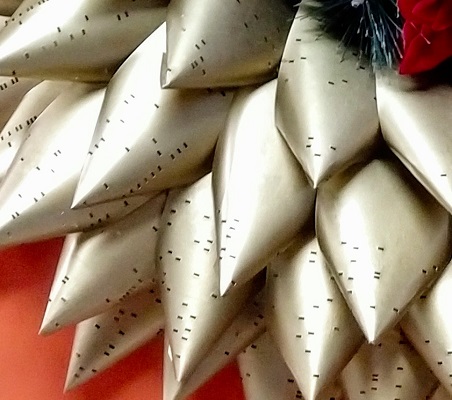
 1960s trend: IBM punch cards repurposed into Christmas wreaths, blending tech and holiday crafts.
The 1960s saw an unexpected convergence of technology and holiday decor with the rise of IBM 029 punch cards as a popular material for crafting Christmas wreaths. This unique trend emerged at the intersection of the computer age and DIY craft culture, creating a distinctive mid-century Americana artifact.
In 1928, IBM introduced a standard punched card format of 80 columns, 12 rows, and rectangular holes. These cards peaked in the 1960s as a crucial component of data processing systems. Dorothy Lynch (1933-2008) of Milton, DE, was one of the nation's first punch card computer operators, programming IBM computers for DuPont Corporation.
As computer technology grew, millions of punch cards were produced and discarded. A December 1956 News Journal article quoted Motor Vehicle Commissioner Charles G. Moore discussing their new computer system: "The present title and registration files consist of 1,150,000 punch cards, while the present license cards consist of 1,300,000 punch cards." For just one state government department, over 2.4 million punch cards were in use. Multiply this across all government departments, businesses, and institutions across Delaware, and the number of punch cards in circulation was enormous.
Repurposing these ubiquitous cards into holiday decorations likely arose from several factors. Their uniform size and shape made them ideal for constructing wreath forms. The cards' crisp edges and modern appearance suited the 1960s aesthetic, which embraced geometric shapes and futuristic designs.
Upcycling discarded materials into decorative items gained traction during this period. As environmental awareness grew, transforming office waste into festive decor was appealing. This creative recycling addressed the increasing paper waste generated by expanding computer use in business and academia.
Creating an IBM punch card wreath was straightforward. Crafters collected discarded cards from local businesses or computer centers, often for free or minimal cost. The cards were folded into fan-like shapes and arranged in a circular pattern, fastened together with staples or glue.
The resulting wreaths had a distinctive appearance, with the uniform white, pink, green, tan or pale yellow cards creating a monochromatic base. Some crafters left the wreaths in this pristine state, appreciating the modern, minimalist aesthetic. Others embellished their creations with paint, glitter, or small ornaments for a traditional festive touch.
This trend wasn't isolated but part of a broader cultural movement toward creative upcycling. Punch cards weren't the only instance of converting trash to holiday decorations; for example, there was also a fad for making wreaths out of dry cleaner bags and wire coat hangers. This wider trend reflected growing environmental awareness and a DIY ethos that sought beauty and utility in discarded items.
The popularity of IBM punch card wreaths spread through various channels, leading to at least one published guide on the craft. In 1971, a printing company in Park Ridge, Illinois, published a booklet titled "Make it With Punched Cards." "Punched cards, the computer age scrap, have sparked the imaginations of people who enjoy doing handicrafts,” stated the booklet’s preface. “Combined with tiny Italian lights, reflecting on and through the holes, the punched cards make decorations that literally sparkle and glow!" The booklet noted, "Probably the most popular of all the decorations has been the punched card wreath."
Craft magazines and home economics classes often featured instructions for making these unique decorations. Office holiday parties became venues for showcasing these tech-inspired creations, with some workplaces holding competitions for the most creative use of discarded punch cards.
This trend reflected the growing influence of computer technology on everyday life. For many, these wreaths represented a tangible connection to the exciting world of computers, still largely mysterious to the general public. Displaying an IBM punch card wreath signaled modernity and embraced the promise of the technological future.
Interestingly, the popularity of these wreaths created an unexpected problem for some businesses. As word spread about the craft potential of punch cards, companies fielded requests from eager crafters for used cards, raising data security concerns. Some organizations implemented policies to ensure used cards were thoroughly destroyed rather than released for crafting.
The IBM punch card wreath trend also reflected broader cultural shifts of the 1960s. This decade marked rapid social and technological change, and repurposing these symbols of the computer age into holiday decorations domesticated and humanized new technologies. It bridged the traditional warmth of the holiday season and the cool efficiency of the computer age.
As the 1960s progressed into the 1970s, the popularity of IBM punch card wreaths waned. Newer data storage methods emerged, making punch cards less common. Additionally, the novelty wore off, and new craft trends captured the public's imagination.
Today, IBM punch card wreaths are remembered as a quirky artifact of mid-century American culture. They represent a moment when the worlds of high technology and homemade crafts collided, producing something uniquely characteristic of their time. These wreaths evoke nostalgia for a period when computers were new and exciting, and the future seemed full of limitless technological possibilities.
In retrospect, the IBM punch card wreath trend can be seen as an early example of tech-inspired crafting, a precursor to today's maker movement and tech-oriented DIY culture. It demonstrates how people have long sought ways to personalize and humanize new technologies, finding creative uses for objects beyond their intended purposes.
The story of IBM punch card wreaths reminds us of the rapid pace of technological change. What was once cutting-edge data storage quickly became obsolete, transformed into a curiosity. Yet, for a brief moment in the 1960s, these simple cards bridged the gap between data processing and holiday traditions, creating a unique symbol of an era when the future arrived in homes and offices across America.
|









I recall throwing some of them in the trash, but when we got recycling bins in office we hope we recycled them by using the bins.
I never had time for crafts, although I did craft some easy things along the way. My extended family, especially the women, in the 1960s got heavily into crafts and I purchased some of those items from family and friends. I never put a wreath on my door and have never seen a Hollerith card wreath but your illustration gives me a great idea what it looked like.
Ron