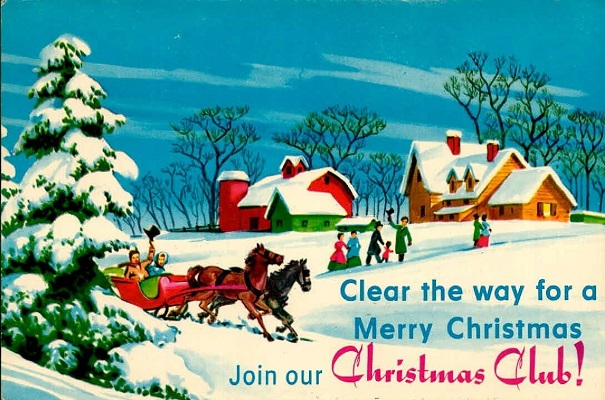
 Christmas Savings Clubs, popular from 1909, helped Americans budget for holidays. Banks loved the interest-free deposits. Credit cards and changing habits led to their decline.
State regulators have permitted banks to operate Christmas Savings Clubs for over a century. These special-purpose savings accounts allowed customers to deposit a set amount of money throughout the year and have a debt-free holiday. Customers could then withdraw the total amount before Christmas to fund shopping, just when they needed to make purchases. Banks loved these clubs because they could hold depositors’ money without paying interest and eagerly competed to attract more customers.
Carlisle Trust Company in Pennsylvania introduced the first Christmas club in 1909, originating the tailored concept. The popularity of the Christmas Savings challenge isn't a mystery. People believed they would spend the holiday money if it remained in their possession, so they entrusted the bank to manage it for them. The promotional system was key to enhancing Christmas celebrations while providing banks with a steady influx of deposits.
The idea of receiving a bit of help saving for the yuletide quickly gained traction. Delaware Trust Company spearheaded the practice’s adoption in the First State. The bank received an enthusiastic response to their 1912 launch. After announcing the start of their yearly Christmas Savings Club, "Several hundred accounts were opened," reported The Morning News on December 27. The bank experienced "almost a continuous stream of people calling at the office at Ninth and Market streets yesterday either to open an account or else to inquire about the Christmas Savings Club."
"The bright young banker—I am sure he was young—who invented the words 'Your Christmas Savings Account,' knew human nature as well as he did the banking business," observed nationally syndicated columnist Idah McGlone Gibson in 1928. "Very few Americans will save for the mere sake of piling up dollars. There is no romance in that—and Americans are the most sentimental people on earth. But they will do so for an object that they think will give them happiness. To have a snug sum to spend on one or more loves will cause many acts of economy that nothing else will do. These Christmas Savings have come to be a yearly account that reaches into millions of dollars in most of the big banks in the larger cities and towns."
Americans found Christmas savings clubs especially popular during the Great Depression. Their touchpoint extended across the landscape, helping people save money for holiday expenses amidst widespread unemployment and financial hardship. Wilmington stores of the era began encouraging consumers to spend Christmas club checks at their establishments. In 1930, Wilmington's Hurley-Powel department store offered to cash Christmas Club checks for shoppers (The Evening Journal). Similarly, in 1934, Wilmington's Stern & Company also provided this service (The Morning News). These merchant efforts demonstrated the significant impact of Christmas Savings Clubs on the local economy and the willingness of businesses to encourage consumer spending.
“Gosh! No wonder Santa Claus is smiling,” crowed the Dover State News in December 1938. “Nearly fifty thousand dollars in Christmas savings funds have been distributed this year by the five Dover area banks. Fifty thousand dollars, or $49,516 to be exact, added to the money available from ordinary sources to be expended on holiday shopping.
“Of course, Santa is wearing a broad grin. There has been much less unemployment in this area than there was during the recent depression. The money from these Christmas clubs means that the cash registers in the Dover shops are going to jingle as merrily as sleigh bells on a frosty winter’s evening.
“And the takeaway means that Mr. and Mrs. Dover, and all the little Doverites, are going to wake up on Christmas morning and find their stockings filled to overflowing with good things.”
Over subsequent decades, interest in Christmas Savings Clubs remained strong, and the practice became widespread across the United States. In 1950, banks were set to distribute nearly $1.5 million through Christmas Savings Clubs to potential spenders, the highest figure in the history of the plan. (The Morning News).
By the decade’s end, at a national level, 13,000,000 Christmas Club members received nearly $1.4 billion, with an average of $108 per member (The Morning News). This 1959 figure represented a healthy increase from the plan's 1910 birth, when 27,000 members saved around $500,000.
Consumers used funds from Christmas Savings Clubs for more than just Christmas purchases. A 1950 study conducted by the Colonial Trust Company found that 60% of the savings were spent, while 40% were redeposited into regular savings accounts (The Morning News).
Bank officials expressed their surprise and satisfaction with the success of Christmas Savings Clubs. J. G. McMillan, president of the Claymont Trust Company, stated that "Christmas Savings Clubs are still serving a good purpose and people realize it is a very systematic way of saving money" (The Morning News).
R. Abbott Sinskey, president of the Colonial Trust Company, described the clubs as "one of the most remarkable forms of savings.” He went on to note that some people who would never think of opening a regular savings account made their payments in the club plan regularly, "almost as though they were repaying a loan" (The Morning News).
Christmas Savings Clubs impacted more than just banks—some companies also organized their own clubs for employees. Milford’s L. D. Caulk Company distributed approximately $87,000 to its Christmas Saving Club members in 1948. Similarly, the Manns Potato Chip Company in southeastern Sussex County in 1963 distributed $7,726 to its employees (The Delmarva News).
These examples demonstrate that companies recognized the value of offering Christmas Savings Club programs to their employees. Such plans provide a convenient and structured way to save money for the holiday season. Companies both support their employees' financial well-being and contribute to boosting the local economy.
By 1967, the banking sector was experiencing increased competition. Banks sought fresh ways to attract and retain customers. Offering interest on Christmas savings accounts became a compelling strategy. Farmer’s Bank of Sussex County stated they would pay 4% interest on the vehicle the following year, becoming the first commercial bank in Delaware to do so. It wasn’t enough.
“In the olden days, Virginia, people used to set up separate savings accounts for holidays. Quaint, huh?” snickered the News Journal in 2006. Several factors contributed to the decline of Christmas savings clubs in the late 20th century. Consumers widely adopted credit cards in the 1950s and 1960s, finding them a convenient alternative to saving over extended periods. By 1985, credit cards had become ubiquitous, enabling consumers to manage holiday expenses without pre-planned savings.
Economic changes, such as high inflation rates in the 1970s and early 1980s, and accompanying financial deregulation, made Christmas savings accounts less attractive. Technological advancements, including digital banking and online shopping, provided consumers with more flexible and efficient ways to manage personal finances and still have a season filled with joy.
Broader cultural shifts with an eye towards December’s time frame, such as changing family dynamics and diverse spending habits, also contributed to the waning popularity of Christmas savings clubs. Implementing aggressive marketing campaigns promoted credit use for holiday disbursements, reinforcing the move away from the annual cycle of money-saving challenges and capitalizing on the growing preference for immediate consumption.
|















When my twin brother and I were born in 1942, our mother started savings accounts for us with our birth money. I'm not sure if she ever had a Christmas Savings Club, but I do recall on our best present combining Christmas and our birthday, on the 21st, was a set of World Book Encyclopedias. They cost the amazing sum of $120 when we were about 8 or 9. She paid $10 a month for the 12 months leading up to Christmas so they could be delivered and displayed under the tree Christmas morning. We knew they didn't come from Santa because we knew that Mom worked hard to save money to buy us Christmas presents that were mostly useful, like clothes.
We used our savings accounts to buy our first used bicycles at 9 years of age. I credit Mom with giving us good sense money management at an early age. All of our earnings went into our savings accounts. We didn't spend money on toys or candy like the other kids. Eventually, we were saving for college and I used savings accounts through graduate school. I eventually got a bank checking account and savings account in 1966 when I received Fellowship money. I didn't open a credit card until I was in my doctoral program when we were traveling a lot in 1972.
From friends that I know that are rather frugal, I've heard that they use layaway plans offered by most of the major retailers. I consider that a replacement for Christmas savings clubs.
Ron