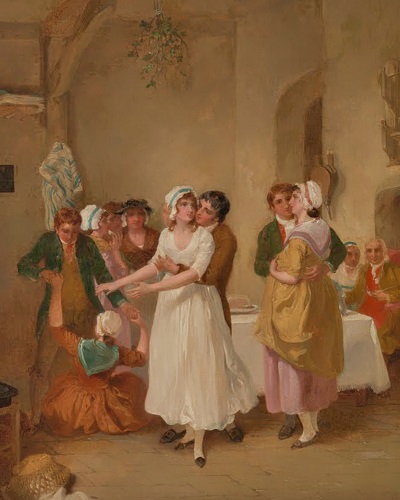
 Delaware's dangerous mistletoe trade, from the 1800s to early 1900s, saw rural workers risk their lives harvesting the plant for holiday traditions and profit.
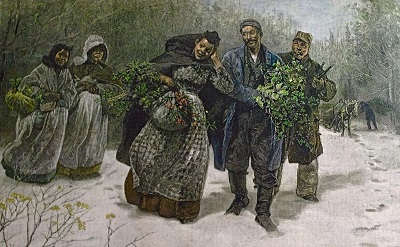
Each Delaware holiday season, from the late 1800s through the early 1900s, mistletoe sprigs would appear statewide in markets and fruit stands, ready to be hung for cheerful décor and stolen kisses. However, before holiday revelers could display these delicate sprigs, seasonal workers had to painstakingly harvest them from the treetops where they grew. Gathering mistletoe required arduous and often dangerous work. The rural poor largely shouldered this hazardous task of harvesting mistletoe.
First State mistletoe pickers would search out the parasitic plant in the swampland forests where it grew wild, primarily in southern Sussex County. The pickers, as described in an article from The Evening Journal in 1902, usually worked in pairs: one climbed high into the treetops while the other remained on the ground. The climbing process was tiresome, requiring the use of a long, flexible hickory switch. The climber would bend the switch around the trunk, grab both ends, and inch their way upwards, moving the switch up the tree and holding on with their knees as they went. Upon reaching the lower limbs, they could then use the branches as a ladder. The article notes that "until a few seasons ago," meaning the late 1890s, this hickory switch method was the only way to reach the mistletoe.
Despite its storied past, some scholars argue that the etymology of ‘mistletoe’ is far less romantic than its reputation suggests. Several sources claim the name is derived from the Anglo-Saxon words "mistel" (dung) and "tan" (twig), referring to the fact that mistletoe spreads via bird droppings. The seeds are surrounded by 'viscin,' a sticky substance that allows them to adhere to tree bark. There, they germinate and grow into new mistletoe plants, sinking roots along the way. Mistletoe is a hemiparasite, producing some nutrients through photosynthesis while siphoning water and minerals from the host. Though the plant can damage or even kill trees in large quantities, mistletoe provides food and shelter for a variety of birds, insects, and mammals. As a result, this parasitic plant plays a crucial role in the forest ecosystem.
By the early 1900s, harvesters had begun using pole climbers, also known as "creepers," similar to those used by telephone linemen. These spiked devices strapped onto the climber's legs, allowing them to dig into the trunk and ascend more easily. However, the work remained incredibly dangerous.
Mistletoe often grows on the outer ends of high branches, forcing pickers to risk life and limb to reach the prize. Consumers desired mistletoe sprigs with berry clusters. The harvesters had to handle the boughs with great care, since the waxy white berries were delicate and easily dislodged. Some tied long pieces of twine to the mistletoe clumps, cutting the stems and then gently lowering them to the ground to avoid crushing the berries. The choicest pieces were then suspended inside barrels or lightweight wooden frames, with strings running through the sides to prevent jostling during transport.
Accidents were not uncommon. Tragically, falls could be fatal. In 1904, The Evening Journal wrote of 14-year-old Willie Henderson from Laurel, who plummeted to his death while collecting mistletoe for his schoolteacher. In 1913, one Rauleigh Harrington, harvesting in Milford, fell 20 feet when the limb he was balancing on broke beneath him. This left Harrington with a broken leg and a badly sprained arm, reported the Morning News.
The work was dangerous, but it could be quite lucrative for the rural harvesters. By 1919, experienced mistletoe gatherers could earn $15 to $20 per day at a time when average daily wages were less than $2. Even children got involved—a 1933 article in The News Journal mentions "men and boys who make a business of gathering mistletoe."
Transporting the mistletoe to market in time for Christmas played a crucial role in the business. In the late 1800s and early 1900s, dealers shipped mistletoe by the wagonload and by steamship. An 1899 article from The Morning News described workers loading the steamer 'Frederica' with 70 tons of dressed poultry and "great quantities of evergreen and mistletoe" in the eponymous town. Dealers gathered this crop from Farmington, Harrington, and Milford to ship it to Philadelphia and Wilmington.
Once the mistletoe arrived, city florists, grocers and other merchants quickly snapped up the bundles. In 1926, nearly 100 dealers were expected to secure permits to sell mistletoe and other greenery along the curbs of Wilmington. Mistletoe prices ranged from 10 cents per sprig to $15 for a whole branch. Supplies could be unpredictable though. The News Journal reported a mistletoe shortage in 1933 after early snow drove flocks of hungry birds to devour the berries, stripping entire forests in a matter of hours. Some savvy harvesters took to covering prime mistletoe clumps with bags to protect the berries from being eaten by birds, allowing the sprigs to be cut closer to the holidays.
While mistletoe harvesting was a local tradition in Delaware, the plant itself has a much longer and more varied history. The ancient plant has long been steeped in myth and tradition, being associated with Celtic Druids since antiquity. They revered the evergreen as a symbol of fertility and vitality due to an ability to remain vibrant even in the depths of winter. On the sixth night of December’s new moon, Druid priests in white robes would cut mistletoe from an oak tree with a golden sickle. They would catch the clusters in a white cloth before the mistletoe could touch the ground and lose any sacred powers. The catch was then used in elixirs to cure all manner of ailments and in rituals to ensure a bountiful harvest.
“A curious legend makes the mistletoe the wood from which the cross of Christ was made,” offered the Newark Post, December 24, 1919. “This was used as an explanation of the fact that the plant is a parasite. For participating in the Crucifixion, the wood was cursed and doomed thenceforth to live only upon the strength of other trees which must give their lives for permitting the growth of the cursed parasite. Because of this superstitious belief, its use in church decorations was forbidden. This prohibition is still in effect in many English and French villages.”
Mistletoe also figures prominently in Norse mythology. Norse legend is believed to have given rise to the tradition of kissing beneath a sprig of mistletoe. As the story goes, the god Baldur was killed by an arrow made of mistletoe — the only thing to which he was vulnerable. His mother Frigga's tears then turned into the plant's white berries, and it was decreed that mistletoe would never again cause harm. Frigga, the goddess of love, then declared that she would bestow a kiss on all who passed beneath the mistletoe from that day forth.
Eighteenth century Englishmen commonly hung a "kissing bough" made of mistletoe, evergreens, ribbons and ornaments as part of Christmas celebrations. A berry would be plucked each time a kiss was stolen, and once the berries were gone, the kissing had to stop. This custom traveled to North America. Washington Irving wrote of young American men "culling" kisses from giggling girls in the doorway under the mistletoe in his 1820 story "Christmas Eve."
The ancient Greeks used mistletoe to treat epilepsy and vertigo, while Anglo-Saxons believed it could heal wounds and increase fertility. Herbalists in the early 20th century prescribed mistletoe for hysteria, headache, asthma, and heart conditions. Modern research suggests the plant’s compounds may help manage high blood pressure and boost the immune system in cancer patients.
So, as you hang a sprig of mistletoe this holiday season in Delaware, remember not only the local harvesters who risked their lives to gather it, but also the plant's fabled history.
|














So your article left me wondering if mistletoe is native to much of the country whether it came from Europe like some other parasites and then started to grow throughout the United States.
Very interesting to read especially about how the myth got started about kissing.
Ron