Global warming?
Could You Imagine
One drop, two drop, three drop four
Thirsty clouds can't hold much more
Five drops, six, seven, then eight
Storm is waiting at the gate
Pushy fellow blocks the sun
Absorbent puff ball weighs a ton
How can one with so much mass
Float?
He must be full of gas!
Pax
A
7/07
Imagine if I knew what I was taking about???
(Rain storm today)


 Share
Share Print
Print Save
Save Follow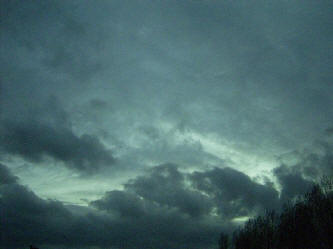












~Butch Howard
Enjoyed to read you again!!
Love Tinka
YOU have been missed. You haven't lost your edge: finally got some of the rain we've been having for ... months ... weeks ... DAYS! Two days, now, in a row, no wet: whoo-hooooooo! Chance of it in the forecast through the rest of July. Temps nice, though: not complaining. :) An excellent write, and LOVE the pic. A StormSpinner kinda poem!
(((HUGS))) and love, Karla.
'Imagine if I knew what I was talking about?'
It's easy if you try
No reason below us
Above us only why...
Imagine all the people, talking common sense, yoo hooooooooooo:):):)
(muhaha!)
I think most of us could apply this statement freely to oursels', hen
Cheerie:)
Some stuff I found on the internet......
sometimes I will write a poem, type in key words on the net, and wind up learning so much......whodathunk???
What do clouds have to do with climate change??
All the researchers answer that as "a lot", but they don't actually know much more than that. A new governmental science mission hopes to be able to add to the climate modelers data sets by more accurately investigating and measuring clouds around the planet. ARM, or the Atmospheric Radiation Measurement program, is the research facility set up to facilitate collaborative working on this problem.
The science behind it:
"The goal of the Atmospheric Radiation Measurement (ARM) Program is to improve the treatment of clouds and radiation processes in global climate models. One of the major goals of DOE is to develop global climate models capable of simulating the timing and magnitude of greenhouse gas-induced global warming and the regional effects of such warming. Previous research has shown that cloud radiative forcing and feedbacks are one of the major sources of uncertainty in simulations of climate change over the next century. It is imperative, therefore, that their treatment in global models be improved.
ARM's goal is addressed through a combination of continuous ground-based observations, data analysis, modeling of local and regional physics, and development of parameterizations for global models. The two principal questions addressed by the Program are 1) how accurate are both longwave and shortwave radiative transfer calculations for any given column of the atmosphere and 2) how well can cloud properties in a column of the atmosphere be predicted from knowledge of larger scale atmospheric properties? Plans and progress made in seeking the answers to these questions can be found in various publications."
Love,
Susan