 Early 20th-century commercial sweet potato farming in southern Delaware is a tale of promise, growth, and sudden decline. The era embodies a microcosm of broader themes in American agriculture.
A Sweet Legacy
The story follows the cash crop’s rise, beginning with a 19th-century acknowledgment of broad market potential.
This ascent, fueled by technological advances, continued through a pre-WWII boom. The narrative concludes with an eventual decline due to (emerging industry displacements.)the displacement by emerging industries.
“The sweet potatoes of Southern Delaware have a richness and sweetness of flavor, which we do not find in the Carolina potato nor even those grown on the rich fresh soils of Texas,” beamed the 1868 ‘Delaware State Directory.’ By the turn of the 20th century, Sussex County agri-business was able to harness the sweet potato’s promise as a primary cash crop. Between 1900 and 1930, the peninsula’s combined bushels exceeded those of all other sweet potato-producing states, except the Carolinas and Georgia.
Fueling the Growth
Two changes exponentially propelled the sweet potato market. First, radio’s new advertising techniques boosted demand in broader regional markets. Second, Delaware’s development of an integrated trucking and rail delivery network provided farmers with the means to swiftly deliver their produce at times of peak demand.
Farmers dug their sweet potatoes in early October. But housewives weren’t especially interested in serving them until Thanksgiving and Christmas.
Meanwhile, the timing of supply and demand rendered the marketing of sweet potatoes unprofitable (seasonal). Growers, in the interim, stored each annual harvest in their own ‘potato house.’
Come holiday season, a broker purchased their “sweets” and transferred them to large wholesale facilities. Railways in Laurel or Seaford, or barges on the Nanticoke River, conducted the final shipping.
Brokers and Shipping
Many of the farmers worked closely with J. A. Morgan (the era’s largest year-round produce broker), who eagerly purchased their harvest. Morgan considered sweet potatoes his number one money-maker.
In 1921 Seaford’s mayor, John Eskridge, built Delmarva’s largest sweet potato storage house, with a 100,000-basket capacity. Johnson & Company’s 1927 facility dwarfed Eskridge’s plant, boasting a larger 250,000-basket capacity. Seaford’s surrounding countryside produced approximately 250,000 baskets by 1935. The town emerged as the regional center for commercial storage. Up to 1,200 railroad cars filled with sweet potatoes left neighboring Laurel annually.
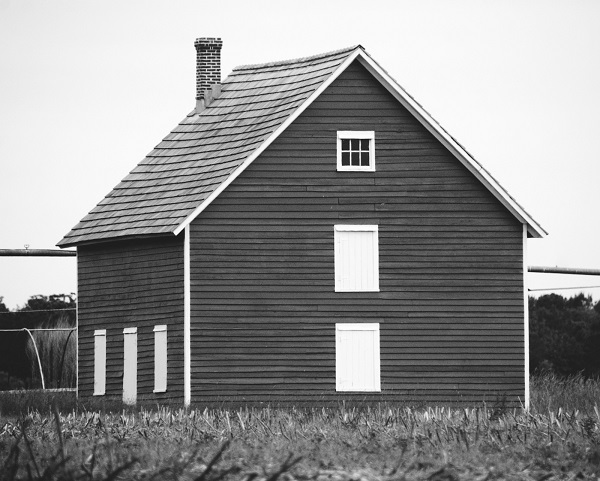
Meantime, the small-scale, single farm potato house was a functional structure built for maximum air flow and insulation. Farmers developed these two-story wooden frame structures to maintain a constant temperature during the October to February storage season. The sheds were outfitted with chimneys to vent coal stoves, fueled by anthracite (not bituminous!) coal for steadiest heat. A concrete-lined cellar in some houses added to the mix root cellar functionality.
Inside the Potato House
The buildings’ slatted floors, and spaces at the top of the walls between wall and ceiling, allowed for essential air circulation. Sliding interior panels at doorways, coupled with hatched exterior doors, gave extra insulation to keep heat in and cold out. Double or triple wall sheathing and the use of insulating paper like ‘red rosin’ or straw reinforced insulation as well.
Some farmers rented out storage bins in their houses to other farmers, marking each bin with tags listing renter information and the number of bushels stored. The bins were generally 9 by 3 feet.
Sweet potato farming’s dominance was not to last. Potato house fires were a constant threat. The combination of a tightly enclosed space, straw insulation dried out to its maximum, and coal stoves throwing out sparks meant house fires often destroyed a farmer’s entire potato crop. And potato houses were rarely insured.
Widespread black rot disease appearing in 1940 crippled farmers for several seasons. High labor costs that had been building for years only added to the struggles. Furthermore, potato houses located in prime business sections of Sussex County’s towns were beginning to be seen as an eyesore. “Another improvement to the business section of Laurel was made during the past week,” said the ‘Delaware Leader’ in April 1940, “with the removal from Second Street of a large, sweet potato storage house.”
A New Era in Farming
The broiler chicken industry was simultaneously rising to market dominance, providing another contributing factor to sweet potato cultivation losing its stronghold. “Now the chicken business is carrying the people, then it was the sweet potato,” farmer Norman Lowe explained in a 1988 oral history with University of Delaware’s Judith Quinn. As the chicken industry flourished, the sweet potato house’s functional era drew to a close.
Today, twelve potato houses in Sussex County are listed on the National Register of Historic Places. “Delaware, until the last twenty years’ frenzy of suburbanization and demolition, has been a prime laboratory for the study of agricultural buildings,” architectural historian W. Barksdale Maynard has noted. Though no longer used for their original purpose, the potato houses’ solid construction and unique design remain an enduring symbol of agricultural resourcefulness in response to new market conditions.
The legacy of Delaware’s potato houses is a reminder of a sweet era gone by, overshadowed by the rise of new industries, but never forgotten in the hearts of those who once made “sweets” king of First State crops.
|














My partner who had just finished high school in Saigon in 1975 when the Vietcong, so ignorant of what life was like there, came and were astonished as they wrecked the economy with their Ho Chi Minh ideas. One idea was to have the now unemployed occupants move out into the country and become farmers.
My partner and 3 or 4 of her 8 brothers, moved into the country with a small bamboo house and a bomb pocked bit of land with some rice and other supplies to begin farming. Their mother, a refugee from the north and a farmer, gave them instructions on how to farm successfully. They got some chickens and raised them, but for some reason, while they ate the eggs, incubated most and traded their many pet chickens with others for rice and other things.
But their most successful crop was sweet potatoes. My partner showed me a picture of how she got fat eating them while all around them other hopeful farmers were starving. After 3 or 4 years of being successful, they left the farm they had developed and returned to Saigon scheming escapes. She tried about 6 times to escape with some dangerous adventures and eventually was brought to the US by her partner escapee brother in 1992. Today, she enjoys a little farming in my backyard, but no sweet potatoes even though Imperial Sugar, probably from sugar beets, old headquarters, a historical building, is only a few miles away.
I often wonder why nutritious sweet potatoes are only consumed at Thanksgiving and Christmas. White potatoes are consumed year-round. Strange how taste and tradition determines what crops people grow.
Ron