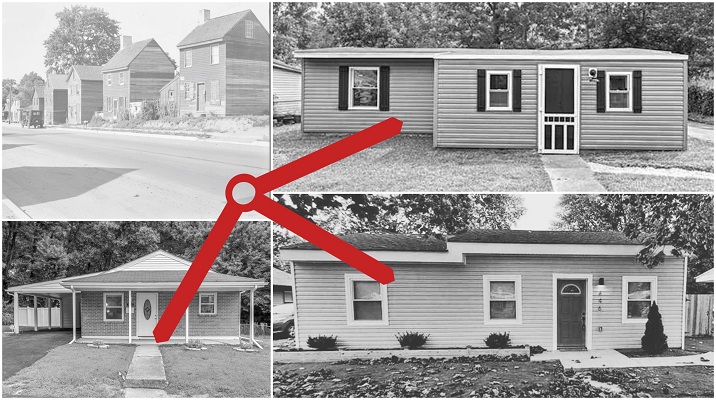
 The complex history of U.S. and Delaware housing policies often perpetuated racial discrimination and economic inequality. Tracing initiatives from the 1930s to the Civil Rights era, the article scrutinizes their mixed impacts.
The housing finance system in the United States underwent a seismic shift during the 1930s, driven by the destabilizing impact of the Great Depression on the housing market.
The turbulence caused havoc on homeownership and catalyzed significant federal interventions. Delaware, shaken by those same forces, took state-level action to stabilize its housing sector.
Great Depression Reforms
A series of key federal initiatives—the Federal Home Loan Bank System (1932), the Home Owners’ Loan Corporation (1933), the Federal Housing Administration (1934), and the Federal National Mortgage Association (1938)—set the stage for mortgage and housing markets for decades to come.
When the Second World War came to an end, FHA-backed loans sparked the post-war suburban housing boom. But they benefited only white homeowners. FHA regulations inhibited the building of new suburban homes for African-Americans. They enforced homeowner covenants that required current homeowners to be white. When the house was later placed up for sale, it could only be sold to other white people.
The policy also served to encourage what would be called “white flight”, especially from public housing to the suburbs. What were mixed-class and mixed-race public housing developments during the 1930s and 40s turned into mostly African-American or Latino housing and apartment blocks consisting mostly of lower class and working poor families.
One cornerstone of federal housing policy that trickled down to the state level was the FHA’s 1949 ‘Campaign for Economy Housing.’ The push aimed to eradicate slums and provide decent housing for low-income families.
In Delaware, as in many states, this Housing Act amendment had mixed effects. For example, Wilmington developer Leon N. Weiner on the one hand capitalized on Veterans Administration guarantees to back home loans to ex-GIs. Starting that year, he constructed Dunleith Estates, an inner suburban enclave of 1,500 single family homes and 500 apartments marketed specifically for African-American veterans. Dunleith was the first privately financed housing project ever built in Wilmington specifically for blacks.
On the other hand, the 1949 drive led to large-scale demolitions and the displacement of predominantly black and impoverished communities. The result was the aggravation of racial segregation and an exacerbation of poverty.
FDR had introduced numerous federal-level initiatives to address housing discrimination. Ironically, these efforts ended up promoting the practice of red-lining. This impact was particularly noticeable in dense urban areas like Wilmington.
Red-Lining Explained
Red-lining is a discriminatory lending practice where financial institutions effectively “red-line” certain geographic areas, usually those where minorities are moving in or might move in. Despite good credit ratings and home conditions, individuals in these areas find it difficult to secure loans.
Initial effects include increased down payments, higher interest rates, and shorter repayment periods. Eventually, local mortgage funds disappear, forcing residents to rely on distant lenders, often backed by federal guarantees. Lenders offering loans federally guaranteed under FHA or VA are often more interested in the guaranteed money than in seeing to it that a neighborhood develops properly so its property values remain stable. This scenario is detrimental to neighborhood development and property value stability.
Additionally, homeowners in red-lined areas struggle to secure mortgages in other areas, trapping them in declining neighborhoods. As loans for home improvements also become scarce, property values plummet, and predatory lending exacerbates the decline, leading to the formation of slums. While lending institutions often deny red-lining, claiming to avoid “unnecessary financial risks,” the practice is rooted in systemic racism, labeling black communities as risks themselves.
Civil Rights Era
In the early 1960s, the Civil Rights Movement began to influence housing policies. Delaware, with its own fraught racial history, felt the impact deeply.
Civil rights activists such as Milford lawyer Louis Redding pushed for the end of housing discrimination, often meeting with stiff resistance. The intensification of urban decay, rising poverty, and a growing awareness of racial segregation meant that a more localized strategy became increasingly necessary.
Dr. Martin Luther King’s April 1968 assassination led to riots and civil disturbances in several cities, including Wilmington. The East Side convulsed with rioting, looting, and sniping, prompting Mayor John Babiarz to enforce a 6:00 p.m. curfew and ban the sale of liquor and firearms. Governor Charles Terry deployed the National Guard to maintain order. The unrest lasted about 10 days.
Meantime, in Washington, DC, just seven days after King’s assassination, Congress finally passed the Fair Housing Act. The act had first been put before Congress in 1966, primarily to address issues of racial discrimination in housing rentals and sales.
In the wake of the riots, and to address the enduring frustrations within Wilmington’s black community over slow-moving civil rights progress, four New Castle County representatives advocated for the creation of a State Department of Housing as well as enhanced public amenities.
This explosive atmosphere compelled Delaware government to create, in October, the Delaware State Housing Authority (DSHA) to address these specific challenges.
In 1969, the DSHA established the Housing Code Task Force to create a State Housing Code, filling a regulatory void and enhancing its enforcement capabilities. A year later, the DSHA gained division status within state government, reflecting Delaware’s growing prioritization of housing issues and giving the agency more influence. By 1971, the DSHA committed $3 million to the Housing Development Fund, enabling the agency to launch ambitious housing projects.
The tangible impact of these cumulative efforts materialized in 1972 with the construction of Holly Square, the first state-financed affordable housing site dedicated to elderly Delawareans. This Middletown project claimed to embody the authority’s mission to provide high-quality, affordable housing for vulnerable populations. However, DSHA sited the home in a white suburban environment far from the slums of Wilmington.
From the 1930s efforts to stabilize the housing market onward, the benefits for the black community have remained uneven. This inconsistency persisted through to the establishment of the Delaware State Housing Authority. Both federal and state initiatives frequently failed to effectively address Delaware’s racial housing discrimination. Too often, these measures worsened the very issues they sought to resolve.
|

























As treasurer of a small community in West Virginia in 1975, I was privileged to see the covenant and learned that the community prohibited almost every ethnic group in the United States other than those of Anglo-Saxon origin, including Roman Catholics. It was appalling. But when I went to sell my house there three years later an African-American student at the university approached me about buying it for his fraternity. I quickly learned he was only fishing, left for Atlanta and the realtor sold it to a young couple 6 months later.
In Atlanta, as I traveled through southern communities, it often happened the southern part of each little town was poor and black. While the northern part of the town was white and prosperous. The Southern way of dealing with the freeing of the slaves and how Jim Crow laws segregated the communities up until the Great Depression and the reforms you mentioned not working very well.
In Houston, I worked for Texas Southern University, a separate, but unequal University predominantly for black students for 30 years. As director of land, I was familiar with covenants various developments in the area. Most were built in the 1940s and were predominantly Jewish, another sector of Americans denied access to housing except in their own communities. In 1947 when TSU was given a sector of land set aside for the University of Houston, nearby, that had a railroad running through it, the property was surrounded by these Jewish communities.
Although all of the developments had covenants prohibiting selling the properties to black people, most of the Jewish people left further west to an area called Meyerland and gave up their property to black families. Some of these homes around campus were very nice and substantial. On the north side of campus were still many shotgun houses built by landowners to house black menial workers for the city businesses. Most of those were rented. Some have become historic today, but many are still rented.
Since the whole area is very close to the rapidly growing Houston Medical Center, property values have skyrocketed forcing many of the black residents to leave because of increased taxes that goal along with their property values.
Ron