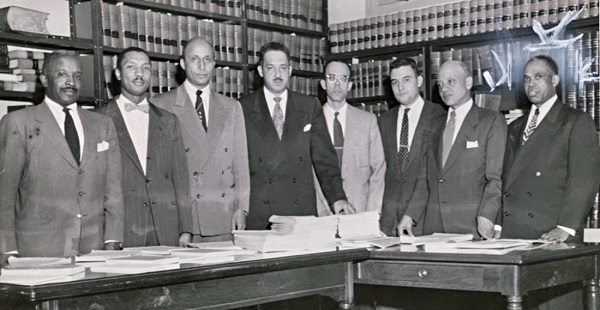
 Delaware's schools serve as a critical stage for the nation's ongoing battles over educational inequality and segregation. This article traces the state's fraught history, from Plessy v. Ferguson to groundbreaking cases that laid the foundation for the landmark Brown v. Board of Education ruling.
Delaware's schools are more than classrooms; they're a battleground where the nation's broader struggles with educational inequality and segregation have been fought.
The 1896 Supreme Court decision in Plessy v. Ferguson established the 'separate but equal' doctrine, forming the legal cornerstone of Delaware's school segregation well into the 20th century.
Although Delaware amended its constitution in 1897 to technically comply, it perpetuated chronic inequality by underfunding schools in black communities. Despite the prevailing 'separate but equal' doctrine, decades passed with little improvement, leaving a vacuum that civil rights organizations like the NAACP would soon seek to fill.
The NAACP in 1939 highlighted the glaring deficiencies in black schools, particularly in Wilmington where a growing population strained limited resources. These schools lacked basic amenities.
As late as 1950, no public black high school south of Wilmington offered a college prep curriculum.
Not until that decade did significant legal challenges to Plessy v. Ferguson begin to emerge, primarily spearheaded by the NAACP’s Legal Defense and Education Fund (LDEF).
The Fund had a particular focus on education and had been actively searching for potential cases to challenge Plessy v. Ferguson. This battle was often concentrated in southern and border states, like Delaware, where segregation was explicitly mandated by law. Their legal efforts, however, met with only modest successes until the year 1950, which witnessed three landmark victories.
The nearly identical cases of Belton v. Gebhart and Bulah v. Gebhart originated from parents petitioning for their black children to attend closer, all-white schools. While both suits challenged the inferior conditions of schools for African Americans—Ethel Belton in Claymont and Sarah Bulah in Hockessin—Bulah's case stood out for its unique circumstance: she was a white woman with an adopted black child.
Louis Redding, the first African American admitted to the Delaware bar, argued both cases in Delaware's Court of Chancery, demonstrating his vital role in the state's fight against segregation. Vice Chancellor Collins J. Seitz presided over these cases.
In both Belton v. Gebhart as well as Bulah v. Gebhart the parents' requests were denied. Although state law supported public school desegregation, the board of education in practice objected to desegregation.
In a statement that would echo through the decades, Judge Seitz observed, “I conclude from the testimony that in our Delaware society, State-imposed segregation in education itself results in the Negro children, as a class, receiving educational opportunities which are substantially inferior to those available to white children otherwise similarly situated.
Though both cases were lost at the state levels, both went on to win in the Supreme Court. The high court granted relief to the individual plaintiffs, but refused to consider the larger question, the constitutionality of the "separate but equal" doctrine.
The NAACP’s third landmark case of the early 1950s was Parker v. the University of Delaware. Redding teamed up with LDEF lawyer Jack Greenberg on this case, with Collin Seitz once more as presiding judge.
Greenberg, the newest staff lawyer at LDEF and married to a Wilmington native, became an invaluable collaborator with Redding, further strengthening Delaware's legal challenge to segregation.
Both attorneys, known for their methodical approach and strong convictions, formed a synergistic partnership. Their mutual respect was evident: Redding saw Greenberg as genuinely committed to the cause, while Greenberg regarded Redding as a standout advocate for civil rights in Delaware. This mutual respect sharpened their legal strategies, avoiding the ego clashes that can derail a team's effectiveness.
The Parker v. University of Delaware case exposed stark inequalities between Delaware State College and the University of Delaware. Redding identified ten black students from Delaware State College who were willing to challenge their rejection from the University of Delaware. The college had long suffered from state underfunding and lacked national accreditation as late as 1950.
Redding took on the legwork and the preparation of local witnesses while Greenberg worked to coordinate the Parker strategy with the other activities of the LDEF.
Their hard work found a sympathetic ear in Judge Seitz, who applied a rigorous interpretation of the "separate but equal" doctrine and ruled in favor of the plaintiffs, deeming Delaware's educational facilities decidedly unequal.
The University of Delaware became the first American college court-ordered to desegregate, foreshadowing the 1954 Brown v. Board of Education decision. Jack Greenberg observed, 'Although Louis [Redding] had to campaign to persuade qualified black applicants to enter the university to capitalize on his victory, the case did have an impact in Delaware.'
While the Parker case may have stayed out of the national spotlight, it laid a foundational block for the fight against segregation and educational inequality. Delaware's legal struggles didn't just set precedents; they paved the way for the groundbreaking Brown v. Board of Education ruling, marking Delaware as an unsung hero in reshaping American educational policy and social norms.
|


























For thirty years I served Texas Southern University in various capacities ranging from special assistant to the vice president of administration, director of land, facilities and energy conservation. Throughout that time I realized, that while returning black veterans from World War II wanted to go to law school at the University of Texas in Austin, and filed suit to get it, the state legislature saw fit to establish a separate, but unequal, Texas College for Negroes in Houston, Texas in 1947. By 1951, the name was changed to be more suitable, but the funding for the institution was not leveled with other state colleges until 1983 after a study comparing TSU with six "sister" institutions I had the privilege of visiting at that time.
But the struggle continues… Houston Independent School District was taken over by the state this year. The combination of white flight and charter schools increasing segregation returns Houston and many cities back to the old ways of Jim Crow.
Ron