 Discover Max Adeler's forgotten Delaware Christmas humor, featuring a nose-biting fish tale. Explore 19th-century wit that charmed readers and baffled fish alike.
In the late 19th century, as Mark Twain delighted readers with his incisive takes on American life, another humorist from the Philadelphia area was making his mark with his own distinct brand of cleverness. Enter Charles Heber Clark—better known by his pen name, 'Max Adeler'—who, in his debut book "Out of the Hurly-Burly," masterfully portrayed the quirks of a Delaware Christmas with sharp wit and a keen eye for the absurd.
Published in 1874, "Out of the Hurly-Burly" struck a chord with readers both in America and abroad. Clark's style was often compared to that of other nationally well-known writers of the era. In its review of the book on July 24, 1874, The Welshman noted, "Most of the good things in the droll department of literature come from our American cousins, and the volume now before us is about the drollest of them all." The newspaper went on to compare Clark's work to that of Bret Harte and Artemus Ward, placing him firmly in the pantheon of great American humorists.
How well has Clark's humor held up over time? In 1947, Professor August H. Able III of the University of Delaware described it as 'old-fashioned, unsophisticated, and involving gross exaggeration.' However, John P. Reid, who runs the website 'Collecting Delaware Books,' has observed that modern readers might find Hurly-Burly 'not much different than television sitcom humor,' suggesting that Clark's comedic style has maintained its appeal across generations.
Clark's most famous work was a loving burlesque of New Castle, Delaware, where the author lived for a time. Published in 1874 under his pen name, the book was a runaway success, with later editions boasting of a million copies in print. It captured the essence of small-town life in Delaware, blending slapstick humor with precious glimpses of New Castle as it was in the latter 19th century.
In the preface to "Hurly Burly", Clark eloquently expresses his philosophy on the importance of humor: "Fun is the most conservative element of society, and it ought to be cherished and encouraged by all lawful means. People never plot mischief when they are merry. Laughter is an enemy to malice, a foe to scandal and a friend to every virtue. It promotes good temper, enlivens the heart and brightens the intellect."
The reception of "Out of the Hurly-Burly" differed somewhat between American and European audiences. The Macomb Journal, on May 20, 1875, praised it as "a thoroughly American book, and thoroughly enjoyable. It is not a book of jests and scraps, but a connected, finished piece of literary workmanship." The newspaper highlighted the book's purity and cheerfulness, noting that it provoked "delightfully spontaneous" laughs that made readers "feel wiser and kindlier than before."
The Macomb Journal's review went on to emphasize the book's broad appeal and moral quality. It noted that "Out of the Hurly-Burly" found "so many eager buyers among classes the most respectable." This observation suggests that Clark's humor transcended social boundaries, appealing to a wide range of readers while maintaining a level of respectability that made it acceptable in even the most conservative households.
The journal also praised the book's visual elements, stating, "We should not forget to mention that the illustrations of 'Out of the Hurly Burly' are profuse and strikingly good. They are 379 in number and every one original." This attention to the book's illustrations highlights the comprehensive nature of Clark's work, combining witty prose with engaging visuals to create a complete entertainment package.
European readers, on the other hand, seemed to focus more on the book's novelty as an American work. The Welshman, in its July 24, 1874 review, noted the curious phenomenon of American humor being so appreciated by British readers. They also commented on Clark's use of language, particularly his adherence to American spelling conventions. In his preface to "Out of the Hurly-Burly," Clark humorously addressed this issue: "The English reader will perceive that the orthography of this book is not in strict accordance with that to which he has been accustomed. I have adhered throughout to the spelling given in the dictionary of Noah Webster, which is the standard authority in the United States. The people of that land are, as it were, under Noah's spell, and I have naturally followed the common practice. It is worthwhile to mention this fact, so that those who are dissatisfied can find fault with Noah and not with me. He can bear harsh criticism better than I can, for he is dead."
This clever explanation of Clark's use of "Noah's English" serves multiple purposes. First, it acknowledges the spelling differences that British readers might notice, preemptively addressing any confusion or criticism. Second, it showcases Clark's wit, using wordplay ("Noah's spell") and self-deprecating humor to charm his audience. Finally, it subtly asserts the legitimacy of American English as a distinct form of the language, worthy of its own standardized spelling.
This adherence to "Noah's English" wasn't just a matter of national pride or convenience; it was part of a broader cultural movement in the United States to establish a distinct American identity in literature and language. Clark's humorous acknowledgment of these variations highlights the growing confidence of American writers in their own linguistic traditions, even as they sought to appeal to an international audience.
Clark's playful approach to explaining these differences demonstrates his skill as a humorist. Rather than simply noting the spelling variations, he turns the explanation into a joke, deflecting potential criticism onto the conveniently "dead" Noah Webster. This ability to find humor in the minutiae of language differences foreshadows the keen observational wit that readers would encounter throughout Out of the Hurly-Burly.
While "Out of the Hurly-Burly" made Clark famous, it wasn't his only contribution to American letters. As noted in The Morning Herald on March 25, 1876, Clark also served as the editor of the Philadelphia Bulletin, where he wrote "funny sketches" every day. This dual role as editor and humorist allowed Clark to hone his craft and reach a wide audience with his particular brand of humor.
Despite his early success as a humorist, Clark's later career took a surprising turn. As reported in The Maui News on January 19, 1901, Clark became "very much ashamed of Max Adeler." He turned away from humor, focusing instead on more serious pursuits. Clark reinvented himself as an economist and manufacturer, becoming deeply involved in trade development and industrial growth.
In this new role, Clark became a recognized authority on economic matters, particularly in the field of tariff policy. He wrote extensively on the economic conditions of the United States and other countries, producing well-regarded works on trade and industry. His writings on the question of tariffs were based on wide knowledge and a profound study of economic conditions, earning him a reputation as one of the soundest economists in the country.
Clark's transition from humorist to serious economic thinker was so complete that, as noted in the Daily Gazette and Bulletin on August 12, 1915, his "contributions to economics will last some time."
The Brooklyn Daily Eagle, on January 3, 1902, noted that Clark had kept his ‘Max Adeler’ identity silent for nearly a quarter-century, choosing instead to be known simply as a "mute, inglorious—businessman." However, the paper also observed that Clark's humorous works continued to sell by the thousands annually, particularly in England.
This shift in focus created a striking contrast in how Clark was perceived by the public. As The Nelson Evening Mail reported on February 18, 1902, when Clark "took to scientific delineation and speculations, he felt flat. It was motley in a surplice, and one was disappointed that there were no cap and bells at the end of the books."
After Clark's passing, newspapers reflected on his legacy with varying perspectives. The Baltimore Sun, in its obituary on August 31, 1915, noted that while Clark had won "a lasting place in the hearts of American readers" with his humorous works, he had come to regret this very success. The paper reported that Clark "persistently sought to efface recognition of his possession of the rarest literary gift, the power to make his readers laugh with him, and strove for a serious place in letters with his last book, 'The Quakeress.'"
The Daily Gazette and Bulletin, on August 12, 1915, offered a broader view of Clark's contributions. While acknowledging his work in economics, the paper noted that his contributions in that field would inevitably be replaced. However, it concluded that "his excellent novels will long be read, but the smiles he created will never fade." The article also highlighted Clark's many years speaking before the Franklin Inn Club of Philadelphia, where he engaged in "a duel of wits" with Francis Hopkinson Smith, delighting members with their verbal sparring.
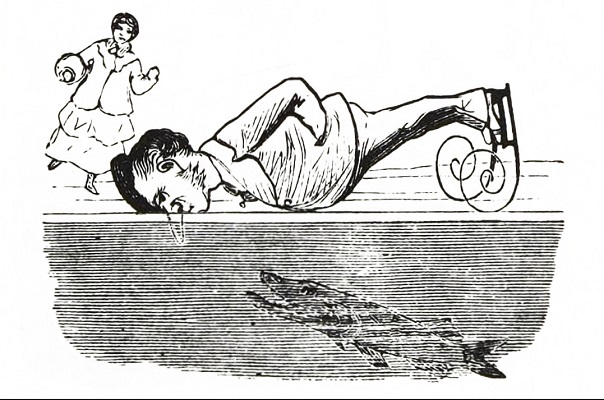
To truly appreciate Clark's humorous take on a Delaware Christmas, one need look no further than his poem "Tim Keyser's Nose," which appeared in "Out of the Hurly-Burly." This comedic verse tells the tale of Tim Keyser, a Wilmington resident with a remarkably red nose, who goes ice skating on Christmas Day. The poem humorously recounts Tim's misadventures when his prominent proboscis attracts the attention of a hungry pickerel while he's taking a drink from the frozen creek.
Through clever rhymes and absurd situations, Clark paints a picture of a Delaware Christmas that is both familiar and fantastical. The poem's blend of local color (referencing Wilmington and the Delaware landscape) with outrageous events (a fish attacking a man's nose through a hole in the ice) showcases his talent for finding humor in the everyday while pushing it to delightful extremes.
Time has not been kind to Charles Heber Clark's literary legacy. Despite his immense popularity in the late 19th century, "Max Adeler" has largely vanished from the American literary canon. This erasure, partly due to changing tastes and Clark's own attempts to distance himself from his humorous works, is a loss for students of American culture.
His quirky, Delaware-flavored humor in works like Out of the Hurly-Burly offers a unique window into small-town life of the era. While modern readers might find his style old-fashioned, Clark's knack for finding comedy in the everyday and his skilled caricatures of local personalities represent an important bridge between the satire of Mark Twain and later homespun American humorists. Perhaps it's time for literary scholars to blow the dust off Clark's forgotten tomes and rediscover the enduring charm of Max Adeler's Delaware.
Tim Keyser’s Nose – A Christmas poem from “Out of the Hurly Burly; or, Life in an Odd Corner”
Tim Keyser lived in Wilmington;
He had a monstrous nose,
Which was a great deal redder than
The very reddest rose,
And was completely capable
Of most terrific blows.
He wandered down one Christmas day
To skate upon the creek,
And there, upon the smoothest ice,
He slid around so quick
That people were amazed to see
Him do it up so slick.
The exercise excited thirst;
And so, to get a drink,
He cut an opening in the ice
And lay down on the brink.
He said, "I'll dip my lips right in
And suck it up, I think."
And while his nose was thus immersed
Six inches in the stream,
A very hungry pickerel was
Attracted by its gleam;
And darting up, he gave a snap,
And Keyser gave a scream.
And just as Mr. Keyser thought
His nose was cut in two,
The pickerel gave its tail a twist
And pulled Tim Keyser through,
And he was scudding through the waves
The first thing that he knew.
Then onward swam that savage fish
With swiftness toward its nest,
Still chewing Mr. Keyser's nose;
While Mr. Keyser guessed
What sort of policy would suit
His circumstances best.
Just then his nose was tickled with
A spear of grass close by;
Then came an awful sneeze, which knocked
The pickerel into pi,
And blew its bones, the ice and waves
Two hundred feet on high!
Tim Keyser then was well assured
He had a splendid bite.
To pull his victim up he jerked
And tugged with all his might;
But that disgusting pickerel had
The better of the fight.
Tim Keyser swam up to the top
A breath of air to take;
And finding broken ice, he hooked
His nose upon a cake,
And gloried in a nose which could
Such a concussion make.
And thus he drifted slowly on
Until he reached the shore;
And creeping out all dripping wet,
He very roundly swore
To use that crimson nose as bait
For pickerel no more.
His Christmas turkey on that day
He tackled with a vim,
And thanked his stars as shuddering,
He thought upon his swim,
That that wild pickerel had not
Spent Christmas eating him!
|


















An interesting fellow that I never heard of, but another Delaware product that you do so well in sharing with us from your historical research.
I recently did a query on the value of Poor Richard's Almanac, and was dismayed at how little they are valued even from 1776.
Ron